
For my children, Aria and Odin: you are the reason and the audience.
For my mother, whose steadiness I still feel.
For my father, the best a son could ask for, who was in my corner every day of my growing up and is still building.
For my life partner, my everything partner, in family, in business, in all of it: I have never met a more amazing woman. You are the wind beneath my wings, and there is no version of this life I would want without you.
And for the man I used to be, scared, hopeful, and in the fire: this is the map I wish you’d had.
Keep going, but not the old way.
The REbuild · An Operating Manual for Life and Business
Copyright © 2026 Chris Kirkman. All rights reserved.
First edition, released Friday, September 1, 2026. No part of this book may be reproduced in any form without written permission, except brief quotations in reviews. The frameworks, checklists, and worksheets are for the buyer’s personal and business use.
Illustrative numbers throughout are examples, not projections or advice. Real estate carries risk, so underwrite everything, and consult your own counsel, CPA, and lender.
Set in Source Serif 4. Designed and pressed as a living book, so owners receive every update.
chriskirkman.com · UnderwritingCalculator.com · chris@chriskirkman.com

First Edition · Released September 1, 2026
What’s in this manual
Continued

I stopped performing and started rebuilding.
For years I mistook motion for progress and intensity for obedience. I built fast, sold hard, and kept the cracks behind the walls where nobody could see them. Then the pressure found the cracks.
This manual is what I rebuilt with, not theory, but the operating system I actually run: faith made practical, truth kept current, systems where I used to rely on force.
It’s written to be practiced, not admired. Mark it up. Argue with it. Turn its pages into scripts, scorecards, and SOPs.
If a page doesn’t change a decision, it hasn’t earned its place. Everything here has to work on a Monday.
What this book is, and what it will do for you
Iwrote this book because somebody handed me the first rung once. A mentor took a call he did not have to take, and that call changed what my family’s life looks like. The REbuild is me handing the rung back.
I am not writing from a stage. I still operate: storage facilities, apartments, restaurants, a design practice. Everything in here is the system I run this week, not a theory I retired from.
And I wrote it because I needed it once. When my life came apart, I did not need motivation. I needed a checklist for Tuesday morning. This is that checklist, grown into a full operating manual.
So it stays practical the whole way through. Every part ends in something you can run the same week: a checklist, a script, a formula with real numbers, a worksheet with your name on it. Read it once for the map, then keep it on the desk and work it; the goal was never a good read, it was a changed ledger, a steadier week, and a life you direct on purpose.
Faith first. Family always. Freedom as the fruit. Practiced, not mastered.
Steel never apologizes for the furnace. Strength is forged in fire, and so are builders.
An operating manual, not a memoir. Checklists, scripts, worked formulas, and worksheets, organized so you can run it front to back or open it to the page a problem lives on.
How to use this manual
Most of us will change careers several times and hold a dozen jobs along the way. So we are all rebuilding already, whether we planned it or not. This book is about doing it on purpose, with a path that runs toward financial freedom and freedom in the rest of your life too.
Read it in any order, but practice it in rhythm: mornings, the Daily Three, the weekly review, the 90-day challenge.
Every page should help you make a cleaner decision, communicate more clearly, close a loop, or serve someone better.
It’s a living document. Your own stories, war wounds, and numbers belong in the margins.
Three vows hold it together: Faith first. Family always. Freedom as the fruit.
Use it as a manual, not a novel: mark it up, skip around, come back to whatever section the week demands. Everything here came from my own mistakes and from people who rebuilt before me, and most of it runs on the 15 REbuild principles.
The REbuild runs as a loop
Not a ladder you finish, a loop you run. Each pass leaves the foundation a little stronger.
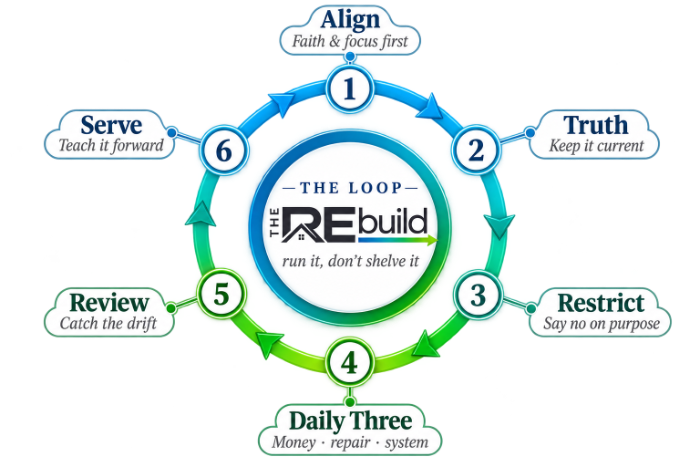
Run it once and you feel better. Run it a hundred times and you are a different person.
Rebuild before you scale.
Growth on a cracked foundation doesn’t buy freedom, it multiplies pressure. Scale magnifies whatever is already true.
Rebuilding isn’t starting over. It’s cleaning the wiring behind the walls: truth, trust, cash rhythm, systems, self-discipline.
My gift is turning broken, overlooked, chaotic things into something valuable. Rule one: point that gift at my own operations first.
Repair before expansion. Systems before scale. Alignment before ambition.
A skyscraper on sand is just a taller way to fall. Fix the ground you’re standing on.
Why real estate and owned businesses, out of every path in this book? Because they are the two vehicles where effort compounds into equity you keep: a building pays you four ways at once, rent, paydown, appreciation, and tax treatment, and a business you own pays you while systems do the work. Trade time for money and the trade ends every night. Own the asset and the asset keeps working while you sleep. That is the freedom this book is driving at.
The REbuild, in one picture
Faith at the center. Everything else built in rings around it, powered by one daily engine.

The posture underneath every decision.
Alignment · Truth & Repair · Discipline.
Execution · Business · Leadership.
Deal Machine · Team · Playbooks · Message.
Daily Three + the Weekly Review turn the rings, every day.
The map: fifteen parts & the toolkit
Alignment
Faith is the posture you choose before the plan is proven.
The 15 REbuild principles
Not slogans. An operating sequence: stabilize what is carrying you, reconceive who you are becoming, then rebuild with focus and leverage.
You are not rebuilding to return to your old life. You are rebuilding to become capable of your next one.
Faith under pressure
Faith isn’t decoration you add once the plan is working. It’s the posture you take before the plan is proven. I am a Christian and I write from that, but this chapter is not a gate: if your path is different, the practice of putting something bigger than yourself first travels across traditions.
Faith has to be operational, it shows up in lender calls, payroll, hard conversations, and the weeks that don’t go my way.
The question was never whether I believe when it’s easy. It’s whether faith governs my behavior when the pressure is on.
Surrender the outcome; own the responsibility. Both, at full strength.
· What am I trying to control that I need to surrender?
· What am I avoiding under the disguise of “waiting on God”?
· What does faithful action look like in the next two hours?
The morning alignment
The morning decides the tone of the day. If the first inputs are messages, problems, and bank balances, the day starts in reaction. Keep it short enough to actually do, strong enough to change your state. This is the ten-minute minimum. The full twenty-minute version, the Morning REconcept, comes later in Part II.
One word, four doors: all four live inside prayer, so that is the word this book uses.
Reset perspective before the day argues with it.
Clear the deck. Own it before you ask for more.
Release the outcomes you were never holding anyway.
Name today’s single most important action.
Name who needs steadiness from you today.
Write the Daily Three the night before, while you are still calm enough to choose well. Then guard the first block: no email, no messages, no news until one of the three is done. Whoever gets your first hour decides your day, and it should be you.
If the routine ever feels flat: write the goal longhand every morning, not once a year on a vision board, and say who you are becoming out loud. Then, and only then, pick up the phone.
I was a workaholic, and I called it ambition
This whole manual exists because I broke something first. Not a deal, not a business. Me. I want you to see how it happened, because it happens quietly, and it happens to people who look like they are winning.
Everything in this book was built little by little, on the other side of that decision. It is not theory. It is the manual I now live off of.
Rebuild the person before you rebuild the money
Most people do not need a new strategy. They need a new version of themselves, the one their family already needs them to be. That person is available, and he is not free.
Be the person your people need before you are the person the market rewards. One of those makes the other one matter.
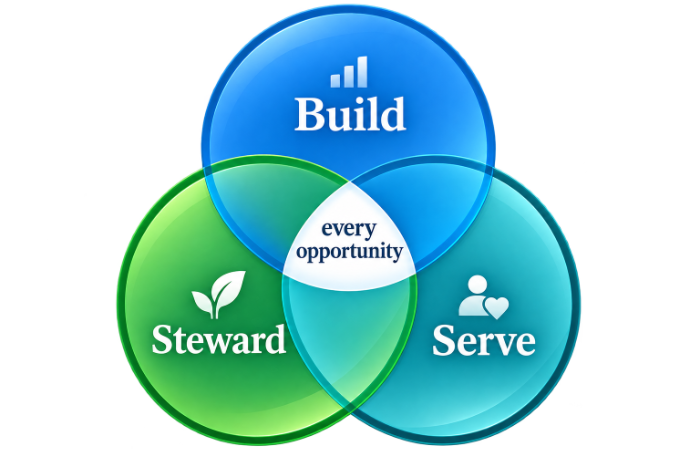
Builder. Steward. Servant.
Identify only as a founder and you chase opportunity. Anchor in three identities and you build with balance. Run every opportunity through all three.
Creates: products, properties, brands, systems. The part of me that makes something from nothing.
Protects and manages what is entrusted: capital, people, family, health, time. The part that keeps it.
Makes the work useful to someone beyond myself. The part that gives it away.
The personal oath
An oath outranks a goal. Goals change with the season; an oath governs how you behave in every season.
Don’t swear to what you won’t honor. Write commitments that survive a bad week.
Cover the whole man, body, mind, soul, relationships, business, money, communication, service.
Write it. Sign it. Swear it to God, not to your mood. Let the oath speak before the emotion does.
· What promise would change my life if I actually honored it?
· What should I stop promising because I’m not ready to honor it?
· Which line must govern my most stressful moment right now?
Write your oath
Before God, and not to my mood, I commit to…
Image is the most expensive thing you will ever buy.
It bills you in energy, trust, sleep, and clarity, and the invoice never stops.

The long road to the Rebuild
I did not start with real estate. I started with a pressure washer, a skateboard company, a food truck, and a roofing crew. I was entrepreneurial before I had any idea what I was doing, and I made every mistake you can make while learning.
As a kid I dreamed of building things with a best friend who was good with his hands. He would run construction, I would run the business and the buying. It took another twenty years, and a lot of odd jobs in between, before I finally stepped into it.
Today I invest in commercial real estate, mostly out of state, and I still lead design with both hands on the craft. The through line was never the industry. It was the instinct to turn something overlooked into something valuable.
The REbuild is that instinct pointed, first, at myself. Faith first. Family always. Freedom as the fruit.

The kid who hated school
I grew up in San Diego County with one sister, a rotating cast of dogs, and two parents who taught for a living. My mother was a teacher. My father was a teacher and later a judge. School was the family business, and I was terrible at it.
I took a long time to learn to read well. I hated the classroom because I could not see the point of it. I played sports and never once tried to be the best. I was not the top student in anything, and nobody would have picked me out of that room.
Then I landed in the high school yearbook class, and something clicked. They handed us templates and I threw mine out and built my own. That was the first time school felt like it was for me, because for the first time it was not about following the page.
I was not a bad student. I was an unmotivated one, waiting for something worth building. That distinction has decided most of my life since.

My first customers were neighbors
At sixteen I bought a pressure washer and started knocking on doors. Fences, decks, driveways. Forty to sixty dollars a job, which at the time meant three CDs or a new set of skateboard parts. I was not building a company. I was learning that a stranger will hand you money if you solve something they can see.
Years later a ten-year-old kid knocked on my door offering to paint address numbers on the curb. He got half the neighborhood. I paid him gladly, and I recognized exactly what he was doing, because it was the same thing.
At seventeen I started a skateboard company. Taught myself Illustrator in a class, got a real license, made clothing, had friends model it, and sold boards out of the trunk of my car at skate parks and shops. My first taste of branding, inventory, and a business bank account.
The lesson was not that I was clever. It was that persistence gets meetings. I was a teenager getting appointments with companies that had no reason to see me, because I kept asking.

How I learned to stack
In college I ran three lives at once. A full-time job doing graphics for a sandal company, their website and catalog and anything else they needed. A full course load toward a computer graphic design degree. And a steady stream of Craigslist gigs I bid on relentlessly.
I did not care what the job was. If it touched design, I would figure it out. I sent proposals constantly and took work I did not yet know how to do, then learned it on the clock.
I also got very good at finishing big projects fast so I could go do other things. Not because I was lazy, but because speed bought me freedom. That instinct became the whole 90-Day Month decades later.
By graduation I had years of real experience most of my classmates would not touch until their thirties. Nobody gave me that. Stacking did. This is where the five twenties started, long before I had a name for it.

The food truck that taught me follow-through
I was sitting in a kayak when the idea hit, and I executed it. A food truck. I was deep in my design career and already running other businesses on the side, but food was brand new; aside from serving tables at a TGI Fridays before I turned 21, I had zero restaurant experience. I figured out everything from scratch: health regulations, permits, commissary rules, where a truck can legally park, then built the branding, the website, and a full year of bookings before it ever rolled.
I wanted to be the visionary. Hands off. Let it run. That is not how a food truck works. I ended up working nights in it, and I burned out hard.
I sold it, truck and all. My first business exit, and not the triumphant kind. But I do not regret a minute of it, because it showed me exactly what I was capable of building from nothing and exactly where I would break.
The lesson I carried out of that truck: commitment and follow-through are not personality traits, they are priorities. If you will not do the unglamorous middle of a thing, do not start it.

The treehouse was the first deal
Between ten and thirteen I had a best friend who was good with his hands. We would ride to the hardware store, buy plywood, and build forts and treehouses. Ours was two stories with a tarp roof, tucked so deep into the branches and leaves of a massive tree that from the street you could not tell it existed. It had power run to it, a radio, a television. At one point a zipline.
I knew then, in the way a kid knows things, that I was going to end up in real estate. He would build, I would figure out how to pay for it and what to do with it. That split never changed.
I also watched my parents sell their first house and roll the equity into the next one. I did not have the vocabulary for it, but I understood that a building could quietly do work for you.
It took about twenty more years and a lot of odd businesses before I finally stepped into it. The instinct was never new. It was just waiting.

The house that felt free
A decade ago I finally asked myself the obvious question: I keep starting businesses, so why am I not in real estate? I saved hard and put over a hundred thousand down on my first investment property, out of state in Oregon.
Then I learned how the machine actually works. I pulled a line of credit against my primary home, not for the purchase but to fund the renovation, and later that same line helped push me into more properties, flips, and rehabs. The play was BRRRR: buy an underperforming house with a basement, add a bedroom, force the value up.
It became a three bedroom, two bath that rented for meaningfully more than the original. When the refinance came through, I had my capital back and still owned the asset. It felt like I had been handed a house for free.
That was the moment it stopped being theory. Flips, new construction, rentals, then apartments, and now self-storage, alongside operating businesses: restaurants, a food truck back then, laundromats in the pipeline now. Same instinct as the treehouse, just with underwriting attached.
The flip that cost me
A Portland flip in 2022. It is the deal I teach from most, because it is the one that went wrong. The work itself came out well. The math did not.
Expensive enough to hurt, cheap enough to survive. That is the best tuition there is.

Good work, bad math

What almost stopped me
Shiny-object syndrome nearly ended me more than once. In my freelance years every opportunity looked like a challenge I could accept, and I could usually make it work. That is exactly the problem. Being capable of everything makes it very hard to say no, and the bill for that arrives later.
I also over-do things. I get intense and push past where a sane person stops. Sometimes that is why I win. Sometimes it is why something breaks that did not need to.
Partnerships taught me the hardest lessons. You cannot partner with just anyone. I look for my opposite in skill and my equal in values, someone whose strengths sit exactly where my gaps are, and who has enough weight in their own life to stay committed when it gets hard.
Moderation turned out to be a strength, not a compromise. That took me twenty years and several businesses to accept, and I am still practicing it.
What I believe about you
Before the tactics, a conviction: you were built for more than one lane and more than a nine-to-five. The manual only works if you believe that too.
We are all capable of extraordinary things. You are not meant for just one job, or just one thing you are allowed to be good at.
You do not have to live inside the constraints the world hands you by default. Most ceilings are painted on.
Aim for the moon. If you land in the clouds, that still beats aiming at the clouds and landing in the trees.
The first step is taking the first step. Clarity comes from moving, not from waiting to feel ready.
· What am I capable of that I have quietly talked myself out of?
· Where am I aiming low because it feels safer?
· What is the one first step I can take this week?
Truth & Repair
Truth is uncomfortable. It is also far cheaper than pretending.
Almost none of it happens
Sit with your worry list from a year ago and count how many actually came true. Not the ones that worried you most. The ones that happened. The number is always brutally small, and the tax you paid on the rest was real.
In one small Penn State study of adults with generalized anxiety, about ninety-one percent of what they worried about did not happen. That is a narrow sample, not a law of nature, and it is still the most useful number I know. Worry feels like preparation. It is not. Preparation writes a plan and takes a step. Worry runs the same footage on a loop and charges you sleep for the privilege.
And of the small fraction that does arrive, almost none of it lands as hard as the version you rehearsed. The real thing is usually survivable, boring, and fixable in a week.
Watch for the fear that dresses itself up as diligence. One more spreadsheet, one more podcast, one more month of research is not caution when the real answer is that you are scared. Name it as fear and the next step gets obvious. Decide before the proof shows up: fear arriving on schedule is not a warning, it is confirmation the decision was real.

You can dig out of almost anything
I have never filed bankruptcy. I have had low, low moments, the kind where the math genuinely did not work and I could not see the next step. Every one of them had a way out. It was never the way I wanted, and it was always there.
Plenty of people whose companies you use every week have been through insolvency, some more than once, and rebuilt into something larger. The bottom was not the end of their story. It was the middle of it.
Rebuilding cash and credit from zero
Two engines get rebuilt in parallel: money coming in this week, and creditworthiness over the next year. Neither one requires permission from anybody, and both respond faster than people believe.
I have lived this floor: foreclosure notices on my own house in Orange County, repossession letters on the car, utilities off, all while running growing companies and paying employees, investors, and private lenders before I paid myself. Momentum returns faster than you think: one year of operating plus three months of honest deposits reopens lenders, and often a working line of credit.
“It takes 20 years to build a reputation and five minutes to ruin it.” Warren Buffett. Guard yours first; rebuild the rest in order.
Nobody is too big for you to face
Sooner or later someone with more money, more lawyers, or more volume will decide you are the easier one to push. The pressure is usually the strategy. They are betting you will fold before anyone has to prove anything.
You are allowed to fight. You are allowed to lose a round and keep going. The only outcome that ends it is deciding you are done, and nobody can make that decision for you.
Watch who speaks when you are at the bottom
On the way up, everybody has your number. Then a season goes sideways and the room changes. Some of the same people who called you an inspiration will quietly decide you were reckless all along. Learn this pattern before it surprises you, because it will.
Applause and condemnation come from the same place: the scoreboard. Neither one is counsel, and neither one gets a vote.
Take advice only from people with scar tissue
The people most eager to advise you are often the ones who have never done the thing. It is not malice. Distance makes everything look simple, and confidence costs nothing when you have no capital at risk. So filter hard, and filter before the hard season, not during it.
Build the short list on a good day: two or three people who have done it, will tell you the truth, and love you either way. Then, in the hard season, call only that list.
The Morning REconcept
Becoming before building. Twenty minutes, same order, attached to the start of your day, whenever your day begins. This is the full version of the Morning Alignment from Part I. On a hard morning, run the five-step minimum instead and keep the streak.
Truth before image
Image management is the most expensive thing I ever bought. It costs energy, trust, sleep, clarity, and time, and it never stops billing.
The longer a truth is delayed, the more interest it charges, money owed, weak locations, missed deadlines, strained relationships, unclear roles.
Telling the truth isn’t dumping emotion. It’s clean facts, plain ownership, and a next step, stated so everyone can act on reality.
Become someone people trust even when the news isn’t good. That’s built through timely truth, not perfect circumstances.
· Where am I managing perception instead of reality?
· Who deserves a cleaner update from me?
· What fact am I afraid to look at because it will require action?
The open-loop ledger
Every unpaid bill, unanswered text, unfinished SOP, and undefined next step is an open loop draining leadership capacity. A ledger turns the anxiety swarm into inventory, and inventory can be worked.
Some loops close in two minutes. Some need a hard, respectful conversation. Both start with the list.
Repair is a leadership skill
Repair isn’t weakness. It’s the skill of restoring alignment after trust, clarity, or expectations get damaged.
Every leader creates damage eventually. The only question is whether people can trust you to return, own, correct, and improve.
Vague apologies soothe the moment; specific repair rebuilds the bridge.
Repair has to be scheduled. If it only happens when guilt gets unbearable, it will always be late.
· Who is waiting for me to repair something?
· What changed behavior would make my apology credible?
· What repair would restore the most peace this week?
The apology that actually heals
It never argues for understanding before it gives ownership, and it never asks the other person to comfort you. Four moves, in order:
Say the impact clearly. They need to know you actually see it.
No long defense first. Ownership before explanation.
The specific change, the calendar entry, the payment, the SOP.
Let them respond honestly, on their timeline, not yours.
Words open the door; changed behavior walks through it.
Forgiveness without denial
Forgiveness isn’t pretending the past was harmless. It’s refusing to let the past run the future.
You can forgive without reconciling. Forgive while keeping boundaries. Forgive while still telling the truth about what happened.
Forgive others who failed you, and forgive yourself without excusing yourself. Stop using shame as a home; use responsibility as a path.
Unprocessed resentment becomes background radiation, it changes tone, timing, decisions, parenting, and risk.
· What story am I replaying because it gives my pain an identity?
· What has resentment cost me?
· What boundary would make forgiveness safer and more honest?
Clear the ledger, then start compounding
You cannot grow on top of a debt you are still pretending is not there. Before the daily one percent means anything, four things have to happen, in this order, and none of them are optional.
Repentance is not a feeling, it is a direction. Turn, make it right where it can be made right, and then get to work.
What co-parenting taught me about repair
I’m not writing from a finished life. My marriage ended, and my two children now have two homes. The work has been making sure that never means two teams. And that ending was a beginning: moving forward is how I became the man I needed to become, and how I found my life partner, the person I was meant to build everything with.
Co-parenting made me practice this whole section for real, tell the truth cleanly, repair fast, forgive without keeping score, and hold boundaries without holding a grudge. In time we even learned to support each other building new relationships.
None of it came naturally. It came from choosing repair over being right, again and again. I’m not perfect, this is practiced, not mastered.
The goal was never to win the split. It was to keep the children on one team.
The trust ladder
Trust builds in levels, on repeated behavior, not big moments. Few relationships reach the top; guard those.
Forgiveness is given; trust is earned. Don’t mistake intensity for intimacy.
The repair plan
Freedom is not doing whatever you want. It is the discipline to choose the future you do.
Restriction is not deprivation. It is clearing room for the future you actually want.
Discipline & Restriction
A crowded life cannot receive a clear calling.
Room to focus
What you remove makes space for what matters. A clear desk, a clear mind.
Restriction creates room
Restriction isn’t deprivation for its own sake. It’s clearing space for something better.
A crowded calendar can’t execute. A crowded mind can’t hear wisdom. A crowded business can’t scale without breaking.
Restrict what steals focus, cash, credibility, health, and peace: reactive communication, pointless meetings, shiny ideas that don’t serve the mission, perfectionism when shipping is the job.
Freedom isn’t doing whatever you feel like. It’s enough discipline to choose the future you actually want.
· What small pleasure is costing me a bigger purpose?
· What do I need to say no to so I can say yes to stability?
· What restriction would immediately improve my peace?
Trigger discipline
A trigger isn’t an order. It’s a signal that something inside needs attention. Most expensive problems begin as one dysregulated message, one rushed promise, one defensive call.
Digital rule: your phone is a tool, not a slot machine. Create before you consume; complete before you check.
Energy is a business asset
Energy isn’t a wellness topic. Low energy makes decisions smaller, reactions sharper, creativity thinner, and follow-through weaker.
Intensity is not capacity. Capacity is built, sleep, movement, nutrition, prayer, boundaries, clear priorities, fewer open loops.
A tired leader calls it strategy when it’s really survival. Treat energy like working capital.
Energy is capital you spend
Capacity is built, then spent on purpose. Run the battery down on drama and there is nothing left for what matters.

Guard the fourth cell before you need it.
The calendar tells the truth
Your calendar is a confession, it reveals what you truly believe is important. Design the day, or the day gets consumed. Use recurring blocks instead of repeated willpower.
Blocks beat willpower. Put it on the calendar or admit it is not real.
Consistency compounds
Intensity spikes and fades. Small, faithful reps cross over and keep climbing.
The 90-day rebuild challenge
Long enough to change patterns, short enough to feel urgent. Score the day by what you practiced.
Zero compromise, or it is not a standard
The hard-commitment challenges people run for ninety days all work for the same reason, and it has nothing to do with the tasks. They work because there is no negotiating lane. Build your rebuild the same way.
Discipline is not punishment. It is the price of being someone you can rely on, and I have never found a discount.
One percent better, then again tomorrow
James Clear made the one-percent case in Atomic Habits, and the arithmetic is not mine to claim. What is mine is where I put it: inside a 90-day window with a scoreboard, so the compounding has somewhere to show up. One percent is small enough that a bad day is no excuse, and big enough that a year of it is unrecognizable.
Illustrative math, and the point is the shape: nobody gets one percent for free. You have to go put in the day.
The daily scorecard
On the hard days, make the move smaller, not optional.
A small move keeps the streak, protects the identity, and beats a perfect plan you never start.
Execution
Turn a massive life into three controllable actions.
Do these three consistently and life stabilizes, without requiring a perfect day.
Three moves a day
Small, faithful action, repeated. This is where a life stabilizes.
The Daily Three
Every day needs one money move, one repair move, and one system move, no hiding in the category that feels easiest. Do these three and life stabilizes without a perfect day.
Create, collect, or protect revenue. This one happens before the comfortable work.
Reduce distrust, confusion, guilt, or silence. The past charges interest until you address it.
Reduce the need for future heroics. A checklist, template, role, or scheduled rhythm.
On overwhelming days, make the actions smaller, not optional. A small move is still a move.
Control the inputs
You cannot command the result. You can command the actions that produce it, every day.
Fall in love with the inputs. The outputs take care of themselves.
The three moves, defined
Money move, creates, collects, or protects revenue: lender outreach, investor updates, service sales, deal follow-up. Before comfort work.
Repair move, reduces distrust, confusion, guilt, or silence: a call, payment, apology, update, or reset.
System move, reduces future heroics: a checklist, template, automation, role, dashboard, or rhythm.
Every recurring problem is an unpaid invoice from a missing system. A shared spreadsheet used daily beats an elegant platform nobody opens.
· What follow-up is one message away from money?
· What small payment or clarification would lower anxiety?
· What problem has repeated three times?
The decision filter
Excitement is not a filter. Good opportunities can still be wrong for the season. Run every new deal, product, or partnership through the funnel before it earns a yes.
Schedule the very next action while the yes is warm.
Drop it in a future file and return to the core. A delayed yes beats a chaotic yes.
A plain kanban board keeps this honest: four columns, backlog, this week, in motion, done. Rank the cards top to bottom, work only from the top, and let everything below the line wait its turn. The board is the filter made visible.
The opportunity filter
Question, delete, simplify, speed, automate
Engineering has a sequence popularized by Elon Musk: question, delete, simplify, accelerate, automate. I run the same discipline in operations for one reason, and it is the most common mistake in business and in life: never pay to automate a step that should have been killed.
Should this exist at all? Interrogate the requirement before you touch the work.
Most processes deserve a funeral, not a facelift. Cut before you polish.
Simplify only what survived the deletion. Fewer steps, fewer handoffs.
Shorten the feedback loop. Faster cycles mean faster learning.
Last, never first. Automating a broken process makes the breakage permanent.
Run it backwards and it costs you twice. Automate first and you have paid to make a bad process permanent, then you pay again to unwind it. In code, in kitchens, and in life, delete before you optimize.
Turn complexity into value. That is the whole job.
Real estate, restaurants, AI, design: one gift, pointed at different vehicles.
Stack your twenties
The old rule says eighty percent of your results come from twenty percent of your effort. Here is the twist that changed how I build.
If your eighty percent is as strong as another person’s hundred, then each focused sliver of effort still lands with full force.
So stack several strong twenties instead of pouring everything into one. Five good twenties still add up to a whole, well-lived hundred.
My version, not the textbook: if the 20 percent of effort you give something produces a result that passes, as good as most people’s hundred, then one life holds five twenties. Businesses, faith, family, passions: five majors, none starved, no salary cap on who you get to be.
Why I stopped believing in one career
Most people use the eighty-twenty rule to trim a to-do list. I heard permission in it. If twenty percent of my effort produces eighty percent of the result, and that eighty is genuinely good enough for the job, then I have four more twenties left in the day.
You were not built for one lane and eight hours. Aim for the moon, because landing in the clouds still beats aiming at the clouds and landing in the trees.
Business Architecture
One mission, many vehicles, and a mission that organizes them.
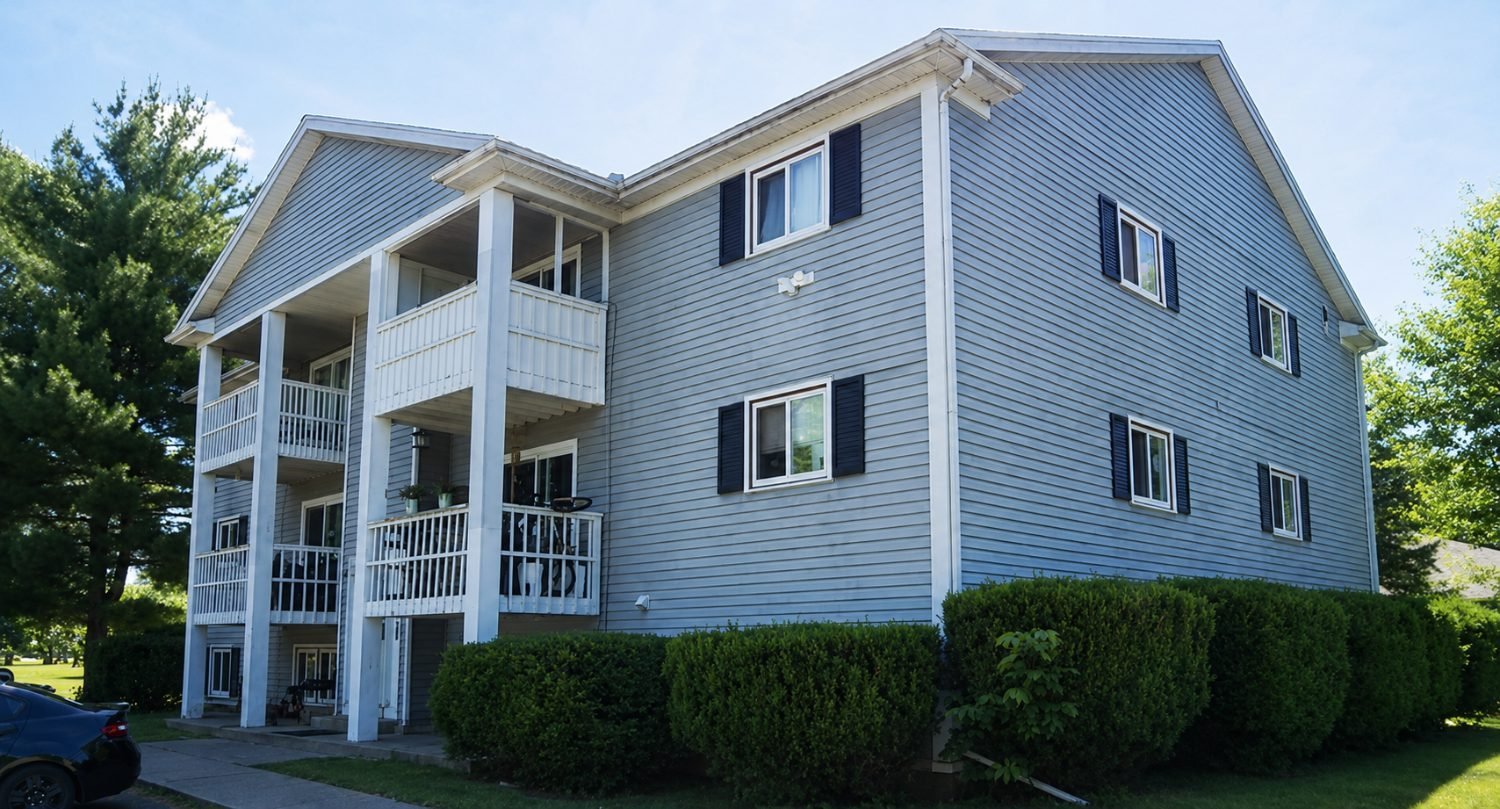
Units under one roof
Why I bought units, not houses
Single-family teaches you the trade. Multifamily teaches you the business. Buying apartments changed what I was actually managing: not a building, but a small operating company with a roof on it.
Do not scale a hobby. Scale a machine.
Sixteen units, fully renovated
Michigan. Eleven two-bedrooms and five one-bedrooms under one roof. We renovated every interior, the common areas, and even the parking lot, then stabilized it to full occupancy. This is what forced value looks like when the work is finished.

stabilized
Everything I have owned, and what it taught
Not a highlight reel. Some of these made money, some cost me money, and every one of them taught me something I still use. The pattern only becomes visible when you list them together.
I was never industry loyal. I was loyal to the instinct: find something overlooked, install systems, make it worth more.

On the deck myself
The roofing company
Commercial roofing, cool-roof coatings on flat decks. Hundred-degree afternoons, my own logo on the shirt, standing on the work instead of reading about it. It taught me more about operations than any office job I ever held.
Do the physical version of your business at least once. It buys you judgment you cannot fake later.
The truck itself
A retired food-service vehicle that served with the NYPD on 9/11, feeding first responders. We kept that dispatch theme, added our own branding, and built the kitchen out ourselves. I hustled every permit and regulation personally, and we opened with eight months of bookings already on the calendar, plus major festivals, and it grew from there as the truck earned its name.


Why I own restaurants
People assume restaurants are the vanity play in my portfolio. They are the opposite. A restaurant will tell you the truth about your operations within a single shift, and a building will let you stay wrong for a year.
If your systems can survive a Friday dinner rush, they can survive almost anything you will meet in real estate.
Can a buyer verify the numbers quickly? Are sales and service documented and measured? Can vendors be replaced without a wobble? Would it run through your two-week absence? The asset becomes more valuable the moment the owner becomes less essential.
Restaurants are also fantastic cashflow for a portfolio, and they exit like real estate: sell the whole business, sell the location and the lease, or sell the equipment piecemeal. It cuts the other way too. We took over a closing Flame Broiler that already had every piece of equipment we needed: paint on the walls, minimal decoration, TVs up for the menus, a Now Open banner while the lit sign got made, and we were serving almost immediately. Somebody’s closing day is your opening day.

The partner is the whole deal
Restaurants are among the hardest things you can start. Thin margins, heavy labor, equipment that fails on a Friday, and a hundred decisions before the first guest sits down. I am here because I did not do it alone.
The good, the bad, and the ugly. Pick the person you would want in all three.
What a restaurant teaches you daily
A building forgives a bad month. A kitchen does not forgive a bad hour. That is why I keep one in the portfolio.


Food cost, labor to sales, ticket times, waste, covers. Five numbers, read every day, no lag and no hiding. I still stand behind that counter, because you cannot fix what you only read about.
We opened the first two Seoulicious KBBQ rooms in one month: a brand-new brand built on my partner’s proven kitchen, because a corner across from Disneyland fell in our lap and we moved. Year one is a working-capital knife fight even on a two-million pace, so hold more cash than you think you need.
Pay your people first, always. Every operator should run something that reports back before midnight.
The BRRRR loop
Buy, Rehab, Rent, Refinance, Repeat. It is the closest thing in real estate to a machine that hands your money back and lets you keep the asset. The point is not the house. The point is that the same dollar goes to work again.
Credit where it is due: the BRRRR acronym was coined by Brandon Turner at BiggerPockets, and David Greene wrote the book on it. I did not invent this. I just ran it.
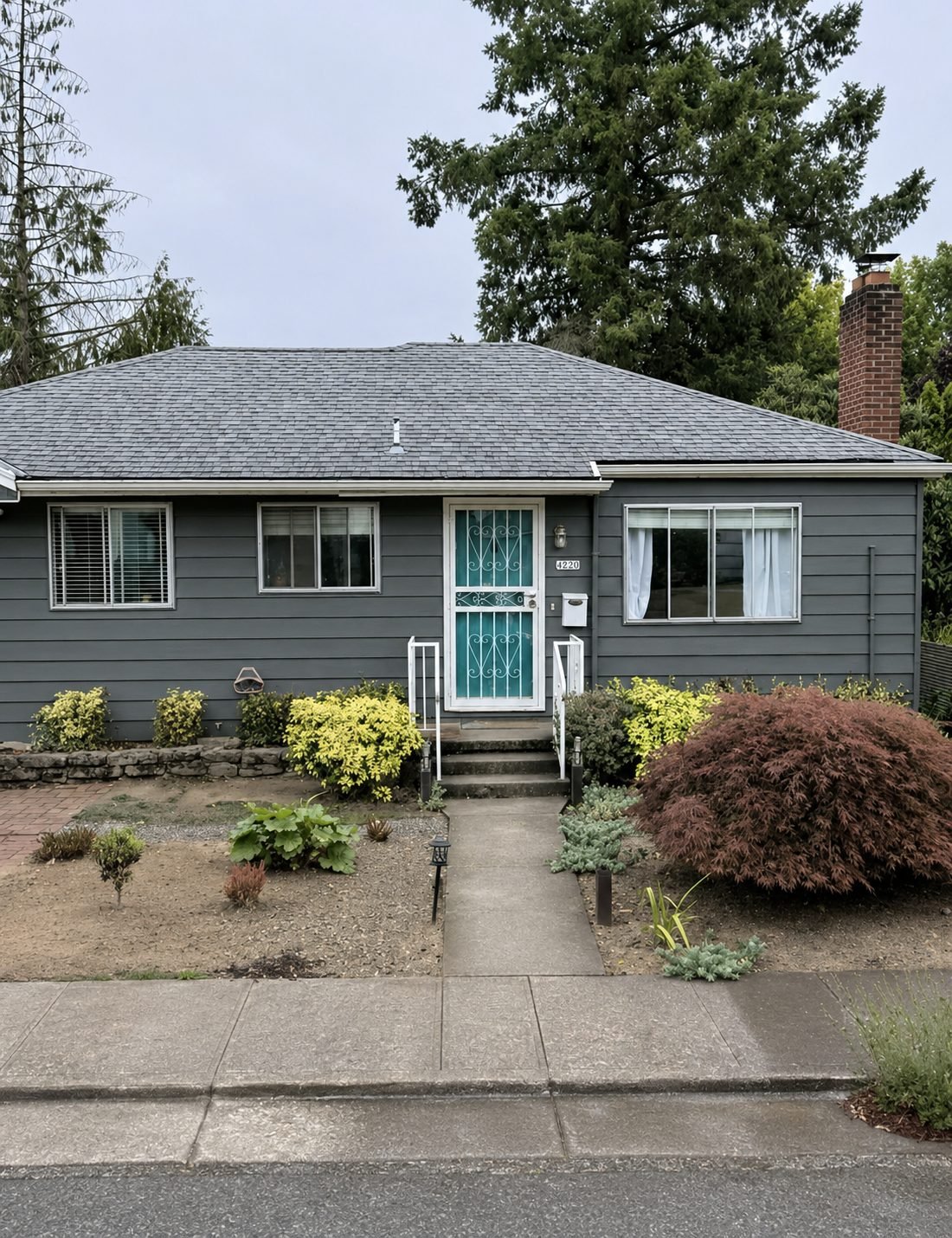
2 bed to 3 bed
My first BRRRR, line by line
I already owned a home in Orange County. A few years later I bought this one in Portland, Oregon as my first real investment. California rarely cash flows, so I went where the numbers worked, and I ran the loop on purpose rather than by accident.
Where the extra bedroom hides
A BRRRR lives or dies on one question asked before you buy: what can I add here that costs little and appraises for a lot? The answer is almost always square footage that already exists and is not counted yet.
You are not buying the house that exists. You are buying the one hiding inside it, and paying only for the first. Refinance proceeds are borrowed funds rather than income, so confirm your own situation with your CPA.
Turn overlooked, chaotic things into value, starting with your own operations first.
The yard at first light
Where the boring wins compound: a clean, well-run facility at sunrise.
One mission, many vehicles
The danger is fragmentation; the opportunity is integration, one thread runs through all of it.
70 · 20 · 10: focus needs math
The core may shift by season, but it cannot be everything at once. Fund ambition with focus; rebalance quarterly.
The current work that stabilizes cash and credibility. It has to win first.
Opportunities that extend the core, revenue without new chaos.
Experiments that may become the next wave, kept small until the foundation is stronger.
A bet that cannot fail safely is a liability wearing a costume.
One machine, not six hustles
Each vehicle feeds the next. Cash funds reserves, reserves fund acquisitions, systems free the hours, and the lessons become the message that brings the next deal to the door.
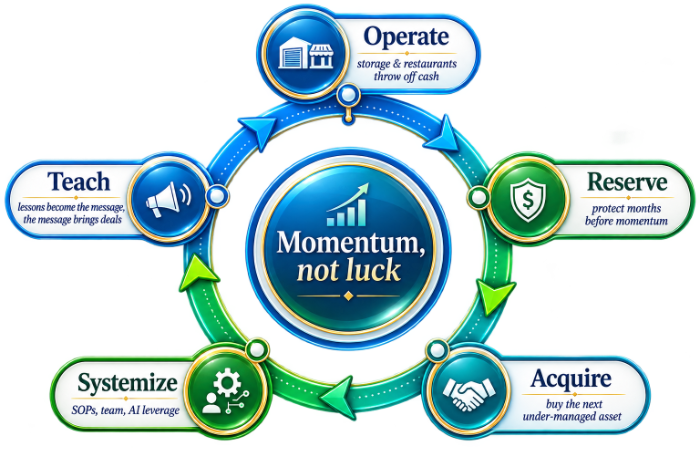
Scale is what happens when you stop being the engine and start building the machine. Grinding harder got you here and will not get you there, because there is no version of you with more hours in the day.
How self-storage actually works
Storage demand is life-transition demand. People rent space when life changes shape, a move, a marriage or a divorce, a death, a new baby, a business that outgrew the garage.
Because it’s need-based, it’s durable. In good times people store the overflow; in hard times they downsize and still need somewhere to put the difference.
The economics are forgiving: little staff, no expensive build-outs, modest ongoing capital, so a well-bought facility breaks even at surprisingly low occupancy.
That forgiveness is the trap. It invites lazy ownership, which is exactly why disciplined operators win big.
· What life transition does my facility actually serve?
· Where am I running this like a landlord instead of an operator?
· What am I leaving on the table because the asset is “forgiving”?
And this is why storage is my vehicle of choice above everything else I own: demand arrives on its own through the doors of life, tenants are sticky and month-to-month at once, there are no toilets and no tenants living inside, breakeven occupancy sits low, one manager can run thousands of doors remotely, and the fragmented ownership map means systems alone can force value. The simplest operations in real estate attached to the most forgiving math. I keep buying it for a reason.
The 5 Ds: the doors of demand
The industry has taught four Ds for decades: death, divorce, dislocation, downsizing. I add a fifth, disaster, because I have watched it fill a building faster than the other four combined. Storage sells to the moments life changes shape, which is why the demand keeps coming in every economy.
Estates, inheritance, a household that has to be held somewhere.
One home becomes two; belongings need a neutral place to land.
Moving, relocation, renovation, the gap between here and there.
Smaller home, empty nest, a business trimming space, the overflow.
Fire, flood, the unplanned, and everyday de-cluttering, the fifth door.
Nobody rents a unit because they want one. They rent because something happened. That is why this demand does not disappear when the economy does.
Market to the moment, not the box. Your customer is mid-transition and looking for relief, not a shopping trip.
Storage & the discipline of boring wins
Storage rewards boring excellence: clean units, working gates, rate management, collections, reviews, call handling, local search, expansion discipline.
The business looks simple, but the details compound. The gate works. The report goes out. The price is adjusted. The customer is answered.
It’s a mirror for life: most wins aren’t dramatic. They’re repeated maintenance done faithfully.
Wealth grows through unsexy systems operated faithfully. The small thing done consistently becomes the big result.
· What boring task would create the biggest compounding effect?
· What operational detail am I underestimating?
· How can I make consistency easier for the team?
The best boring deals hide behind tired owners: below-market rents nobody reviewed, receivables nobody chased, messy books over a fundamentally useful operation. Buy momentum, then improve it. Solve the seller’s problem in the structure without hiding your own risk.
The five dials that move NOI
One asset, five dials, and nothing else. Three raise what comes in, two cut what leaks out.
Raise the NOI, raise the value
You make money in real estate two ways: grow the income or hope the market re-prices. Only the first is in your hands. These are the levers that grow it.
Close the gap between in-place rent and what the market actually pays.
Renegotiate, re-bid, and meter what you were overpaying for.
Fill the vacancy with marketing and a frictionless move-in.
Ancillary revenue, expansion, or unused square footage put to work.
Rebrand, renovate, and re-tenant to a higher class of asset.
Pull the created equity back out and recycle it into the next deal.
Force the value. Do not wait for the market to hand you what your work can build.
Where the NOI is made
Same building, wildly different outcomes, the difference is operating levers. These are the dials a real operator turns.
Street rate for new tenants, priced to demand, and the existing-customer increase, the most under-used lever of all.
Physical (units full) vs economic (rent actually collected). Chasing “full” with endless discounts is how you stay busy and broke.
Win local search, make renting online effortless, and never miss a call, a missed call is a unit rented at the competitor.
Unglamorous and decisive. Autopay, a disciplined late and lien process, clean delinquency reporting.
Tenant protection, locks, boxes, supplies, high margin and easy to attach at the counter.
Revenue per available square foot, occupancy × rate, net of discounts. Not “are we full,” but “is every foot earning.”
The real risk is local
Storage is hyper-local. Most demand lives within three to five miles, one to three in dense cities, up to ten where it is rural, and drive time beats distance every time. National demand being fine won’t save you if three new facilities open one exit down.
New supply is the enemy of pricing power. The best markets are hard to build in, permitting, land, zoning, and density act as supply barriers that protect the incumbent.
Underwrite the ring, not the logo. Drive the trade area. Count the competitors, the cranes, and the entitlements before you count your rent.
Supply, street rates, and population growth inside that ring decide your pricing power. Nothing outside it votes.
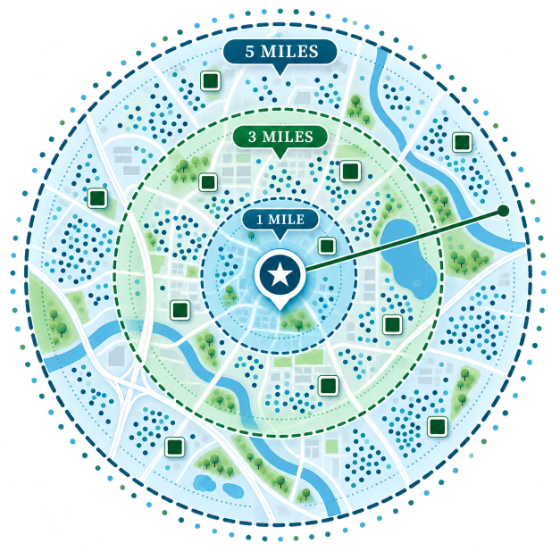
Risk being local is also why I invest out of state without blinking. I would not self-manage a property one mile from my house, I would hire the systems either way, so distance costs me nothing and opens every market in the country. All my rentals are out of state; the flips, new construction, and operating businesses stay local. Buy the market, not the commute.
The fragmented market is the opening
Ownership is deeply fragmented: most facilities in this country are run by independent operators, not the national brands. The big names run a minority; the majority is owned one or two stores at a time.
Many independents run without dynamic pricing, real marketing, or clean books, not from laziness, just from doing it the old way.
Buy an under-managed store, install professional systems, and grow NOI without changing the building. Value you create, not value you hope the market hands you.
· Where is the under-managed asset in my market?
· What professional system would lift NOI fastest?
· Am I buying a building, or buying a turnaround?
Illustrative, the fragmentation, not exact figures. The gap is the opportunity.
Run the business like an institution while it’s still entrepreneurial, recurring cadence, clear numbers, and nobody chasing the truth.
THE REBUILD · PART V

Real estate as stewardship
Commercial real estate isn’t only acquisition. It’s stewardship of risk, capital, people, property, debt, timelines, and trust.
A deal can look good on paper and still turn heavy if reporting, reserves, vendors, or lender expectations are weak.
My advantage is seeing value where others see problems: conversions, land, seller finance, under-managed assets, creative structures.
The next advantage is institutional communication and process. Investors and lenders need to see not just vision, but cadence.
· Where has vision outpaced stewardship?
· What report would make investors feel safer?
· What risk needs surfacing before it becomes a crisis?
Enough CRE literacy to teach it
Six ideas that let you hold your own with any lender, broker, or partner, and coach someone else through their first deal.
Roughly next-year NOI ÷ price. A lower cap rate means the market is paying more per dollar of income.
Grow the NOI (in your control) or hope the cap rate compresses (not). Build value by operating.
Roof, paving, gates, doors. Honest ownership reserves for them instead of pretending cash flow is free.
Most CRE is privately owned; a minority sits in REITs. The private, owner-operated end is where a hands-on builder has an edge.
Shorthand for quality, age, and location. You don’t need trophies, you need honest assets, bought right, run well.
It can create or destroy value and demands enormous attention. Most value comes from operating what you already own well.
Four ways a property pays you
Most people only count the rent check. A property bought right pays you four ways at once, and the quiet ones compound.
Rent minus expenses minus debt. The money that buys patience and pays the family first.
Grow the NOI and you grow the value. This is the paycheck you control.
Every payment, the tenants buy you a little more of the building.
Depreciation and deferral reward long ownership. Get real counsel; the point is that ownership is favored.
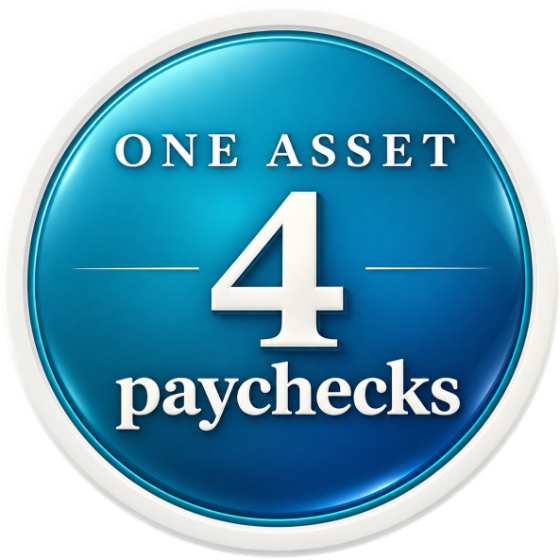
Buy for cash flow. Let the other three surprise you.
The market moves in four seasons
Every market breathes: recovery, expansion, hypersupply, recession. You cannot time it, but you can be honest about where you are. As I write this in 2026, honesty says the conditions are genuinely hard: inflation has outrun wage growth, home affordability sits near its worst level on record, and the share of households renting keeps climbing. Rents are flat while rates sit high, so values compress and loans get harder, and the season rewards two things above all: creative financing and forced appreciation.
Deals are made in every season, but the same deal is not. Underwrite the phase, not the headline.
And it is fine to rent the roof over your own head while owning the roofs over other people’s. Some of the wealthiest people I know rent for the flexibility and the lower carry; the wealth lives in the rent roll, not the front door.
The five numbers on every loan
Debt is a tool exactly as long as the building pays for it, never you. Before you sign, be able to say all five out loud.
How much of the price the bank carries. The rest is your skin in the deal.
The price of money. Fixed or floating, know which one you actually have.
The payoff schedule that sets the payment. Longer am, smaller payment, slower equity.
When the loan comes due. Name the refinance you are quietly betting on.
The cushion between income and the payment. Many lenders want roughly 1.25.
Collected revenue pays operating expenses, then reserves, then debt service, then taxes, and only then you. Equity can make you wealthy on paper; cash flow keeps you alive. Underwrite in that order and you will never confuse a paper win with oxygen.
The value-add bridge, in round numbers
The market hands you the cap rate. You hand yourself the NOI. Here is the whole game on one page, with illustrative numbers kept round on purpose.
$21,000 added NOI ÷ 7.0% cap = $300,000 in added property value.
Illustrative example. Value equals NOI divided by cap rate. Excludes capital improvements, financing, taxes, and selling costs.
Protect the downside first
Offense builds wealth. Defense keeps it. Build the stack from the bottom up, before you press the accelerator.
A desperate operator makes expensive choices. Defense is what keeps you patient.
Finding the deal: the acquisition process
Deals don’t fall from the sky. They come from a machine that runs whether or not you feel inspired, six repeatable steps, fed by many channels.
Who’s your target market? What asset type, quality, and size? Be specific before you spend a dollar.
Find the real owners, individual names, entity lookups, clean contact data.
Verify the data, start the conversation, qualify the lead, and earn permission to keep talking.
Every lead and every touch on one board. A shared system beats the best memory.
Build rapport and gain trust. The deal follows the relationship, not the pitch.
Most deals live in the follow-up. Nurture consistently until the timing turns.
Underwrite the market before the deal
Before a single offer, understand where people and money are moving, and why. A great deal in a shrinking market is still a bad deal.
What opportunity do you actually see in this market?
What are the real risks of investing here?
What choices are people making, moving in, moving out, trading up?
Why are they making those choices?
Where are the opportunities and challenges being created?
Population, jobs, and income moving in, demand tailwind.
Out-migration and shrinking demand, a headwind no deal outruns.
Follow the migration first, then the property.
Choosing the market is the one decision that keeps paying or keeps charging you. A good operator in a growing ring beats a great operator in a shrinking one. Pick the ring once, carefully.
Buying cheap without knowing why it is cheap. Depending on one partner for every local function. Never visiting after warning signs. Aggressive leverage with no room for operational error. The local team is part of the asset. Underwrite the people like you underwrite the roof.
Restaurants as operating schools
Restaurants are unforgiving teachers: labor discipline, cash timing, customer experience, menu economics, vendor reliability, daily execution. Margins too tight for vague management.
They’re not just food businesses, they’re laboratories for systems, AI calling, local marketing, staff training, SOPs, and turnaround lessons.
Every pain point can become a process. Every process can become IP. Every lesson can become content or a service.
Stop letting restaurant chaos stay private pain. Convert it into scorecards, checklists, training, and stories that help other operators.
· What restaurant issue could become an AI or consulting offer?
· What number should every manager know daily?
· What SOP would make the next location easier?
We are all capable of extraordinary things. You are not meant for just one job, or just one thing you are allowed to be good at.
AI as leverage, not escape
I ran ten full-time cold callers in the Philippines. Today an AI agent I built runs that script, and a person still owns the outcome. That is the whole shape of it: the machine does the reps, you keep the judgment.
AI should multiply proven wisdom, not distract from unfinished responsibility.
It can automate calls, summarize leads, score deals, and lift customer experience, but it is no substitute for truth, offer clarity, or follow-through.
Sell the painful problem first; build the elegant platform second. The edge is practical leverage for overwhelmed owners.

Negotiation with calm strength
It gets cleaner when rooted in service: the right person feels understood before they feel pitched; the wrong person isn’t your customer.
Understand their pain, desired outcome, fears, budget, and timeline before you present anything.
Know your ideal, acceptable, non-negotiables, concessions, and walk-away before you begin, and know what they fear losing.
Calm strength: silence over explanation, questions over pressure, ego out of the room. After the yes, move fast on paperwork.
· What must I know before entering the negotiation?
· Where could silence serve me better than explanation?
· What paperwork must be ready before the yes?
Investor & lender communication
Capital relationships run on confidence, and confidence is built on clarity, consistency, and character.
They handle hard news better than vague silence. Tell them what’s happening, what changed, the plan, and when they’ll hear from you next.
Don’t make people chase the truth. Bring it before anxiety fills the gap. This is one of the highest-leverage repairs available.
· Who needs a recurring update instead of occasional explanations?
· What number or risk should be disclosed more clearly?
· What would make me easier to trust with capital?
Hiring for capacity & character
Hiring isn’t filling a seat. It’s transferring trust.
A talented person without humility can do as much damage as an inexperienced one without training.
Look for capacity, work ethic, curiosity, ownership, communication, and the ability to turn problems into process. Two tools: “Tell me more” and “How did you do it?”
Even good people drift when expectations are vague, every role needs a scorecard. Raise the standard and make it visible.
· Where am I tolerating low standards because I fear losing help?
· What role needs a scorecard before I hire or promote?
· What character trait matters most in my inner circle?
The weekly scoreboard
Six vehicles, one operating system. Every chip is a number you can pull weekly and read in a glance. Activity counts belong on a task list; these belong on the wall.
| Vehicle | Core KPIs to review | Accountable owner |
|---|---|---|
Self-storage | Economic occupancyStreet vs achieved rateDelinquency %Move-ins vs move-outsRevPAF | Facility manager |
Restaurants | Net salesPrime cost %Labor %Average ticketCovers | General manager |
AI & services | Contact rateQualified opportunitiesClose rateMRRChurn | Head of growth |
Real estate | Collections %NOI vs budgetExpense ratioDSCRCapex vs budget | Asset manager |
Education & media | Leads generatedList growthConversion rateRevenue per leadContent reach | Content lead |
Acquisitions | Deals reviewedOffers submittedContracts signedProjected returnCapital required | Acquisitions lead |
A scoreboard is not there to judge the operator. It is there to expose the gap early enough to do something about it. Measure the few numbers that change decisions, assign an owner, review them every week, and act before the problem becomes a trend.
Caring is preparation, not warmth.
The checklist made, the expectation set, the person trained before the moment arrives.
Twenty-five sectors, and what is inside each
There is no single official list. Institutions cut real estate differently depending on whether they analyse private property, public REITs, or real assets. This is the taxonomy I use, broader than the old five. Tinted with a dot: the ones I underwrite myself.
Four more doors worth knowing before you commit to a lane. ADUs force value on land you already own; a garage becomes a permitted, rented dwelling. Short-term rentals are hospitality businesses on real estate rails; underwrite the business, not the brochure, because everyone-is-making-a-killing is not a number. Mobile home parks are the other fragmented mom-and-pop asset class; tenants own the homes, you own the land, and turnover stays naturally low. And tax liens, deeds, and foreclosures buy at the courthouse steps: real discounts, heavy diligence, rules that change county by county. Every door works. Pick one, learn its math, and stay until the math gets boring.
Pick the fight you can actually win
Every asset class works for somebody. The question is which one matches the operator you are today. Ops load is the column most people skip, and it decides whether you last.
I started in houses, moved to units, then found storage. Nobody handed me the right asset. I paid tuition in each one until the fit was obvious.
If you only have sixty days, do this
Somebody will read this book, agree with it, and change nothing. So here is the shortest honest path from reading to owning something, with no framework you have not already met in these pages.
Sixty days from today you can own a decision instead of an opinion. Nothing on this page requires permission.
The two ways to win, and the one you control
You make money in commercial real estate two ways. Only one of them answers to your effort. Bet your plan on that one.
Raise income, control expense. Operating work, entirely in your hands.
The market re-prices in your favor. A gift when it comes, never a plan.

The capital stack, bottom to top
The stack is just the list of everyone who funded a deal, sorted by who gets paid first. Cheapest money sits at the bottom and takes the least risk. Every layer above it is a negotiation about exactly that trade.
In a bad year the bank gets paid or the building goes back, then the note, then preferred. Underwrite the stack at the worst NOI you can imagine, never the pro forma.
Senior debt, a seller carry, a small equity partnership. Three layers, three phone calls when something goes wrong, and everyone can say in one sentence who they sit behind.
Who gets paid, in what order
A capital stack is not a list of funding sources. It is a payment order, and every layer buys a claim on your cash flow, your collateral, and your control. Design it around the downside case, not the closing date.
A deal that technically closes but cannot survive an ordinary delay is not financed. It is gambled.
Creative structure solves a verified problem
Creativity in a deal is not cleverness for its own sake. Every unusual term should exist because a specific, named problem needed solving. If you cannot say which problem, delete the term.
Complexity is only justified when it improves risk allocation and still makes sense to your lender, your investor, your CPA, and your attorney. If one of them is confused, simplify it.
The plan is a hypothesis, not an obligation. Once a year, re-run five numbers: forward NOI with honest reserves, current debt and refinance quotes, remaining value-add, the tax and waterfall math of a sale, and what would have to change the answer. Hold, refinance, or sell is a decision you re-earn annually.
Raise money like you will be reporting for ten years
Because you will. The way you raise sets the tone for every update, every hard quarter, and every future deal. Under-promise, over-document, and never sell a projection like it is a fact.
Your first raise is not about this deal. It is an audition for every deal after it, and the audition never really ends.
Rule 506(b) lets you take up to thirty-five sophisticated non-accredited investors but bans advertising, so relationships come first. Rule 506(c) lets you advertise, but every investor must be verified accredited. Pick the door before the first conversation; you cannot switch mid-raise. Either door, the order of capital holds: debt first, seller paper second, preferred money third, common equity last. Give up cash flow before you give up control, and put the waterfall in writing before the wire.
A tax benefit cannot rescue a bad deal
But bad planning will absolutely shrink a good one. Plan before you buy, before you improve, before you refinance, and before you sell. After the fact, most of the good options are already gone.
I am not your CPA and this is not advice. Get a real estate CPA, interview several, and pay for the good one. It is the cheapest leverage on this list.
The two levers that change everything at scale: a cost segregation study, which reclassifies components of the building into 5, 7, and 15 year lives, and bonus depreciation, which lets you take much of that up front. Together they can shelter years of cash flow in year one.
Depreciation is the deduction you did not pay cash for
This is the single largest reason real estate beats most other income. The building wears out on paper while it usually gains value in the market, and the paper loss is deductible. Understand it and you understand the whole game.
Three more doors to walk through with your CPA. Real estate professional status can let a qualifying operator use paper losses against active income; the test is real, documented hours. A 1031 exchange rolls a sale’s gain into the next property instead of the tax bill. And borrowing against appreciated assets puts equity to work without a taxable sale, the quiet engine behind most long-hold portfolios. All illustrative; the rules are strict and this is exactly where a real estate CPA earns the fee. Depreciation defers, exchanges roll, borrowing unlocks. Sequence them with a professional.
Writing off the truck, done properly
Everybody has heard you can write off a vehicle. Almost nobody documents it correctly. The deduction is real, the rules are specific, and the paperwork is what decides whether it survives a question.
Run through my companies, that math is how a heavy vehicle came in at a fraction of sticker after tax. It is not free and it is not automatic: the deduction tracks documented business-use percentage, the vehicle has to meet the weight and placed-in-service tests, personal use is carved out, and selling early can trigger recapture. Same rule, same paperwork.
Illustrative and simplified, and this is what I do rather than advice for your situation. Thresholds, caps, and recapture rules change and depend on your entity and your year. Take the position with a real estate CPA, in writing, before you file.
What operators actually deduct
Ordinary and necessary for the business. Not clever, not aggressive. Here is the map I keep in front of my own bookkeeper.
Repair now, or capitalize over decades
This is the question that quietly moves the most money on an operator’s return. A repair is deductible this year. An improvement gets spread across the building’s life. Same invoice, very different tax year.
Whether your losses are usable at all
You can generate a legitimate paper loss and still be unable to use it this year. Whether real estate losses offset your other income turns on classification, and this is where most investors are surprised.
Documentation is the whole deduction
Every deduction on the previous pages is worth exactly as much as your ability to support it. I have never met an operator who regretted good books, and I have met several who regretted the opposite.
Hold is an active decision, not a default
Every year, every asset gets a verdict: hold, refinance, recapitalize, expand, partially sell, or sell. Use what the property is doing now, not the story you told yourself when you bought it.
Selling is not failure and holding is not loyalty. Both are just capital allocation, and the memo is how you keep yourself honest.
Ten properties is not a portfolio
Ten buildings with the same insurer, the same maturity year, the same weather, and the same operating partner is one bet written ten times. Count your exposures, not your doors.
Storage stays my anchor because I know it best. Everything else has to earn its seat by bringing a real team and a real system with it.
Leadership & Culture
Caring is preparation, not just warmth.
Caring in advance
Preparation is a form of love. Clear the path before your people walk it.
Leadership is caring in advance
Caring is more than warmth. It’s preparation: the checklist made, the expectation set, the person trained, the issue addressed before it becomes resentment.
People need clarity more than charisma, what winning looks like today, and feedback while there’s still time to improve.
Standards repeated often enough become culture.
Leadership isn’t carrying everything yourself. It’s making responsibility easier to understand and harder to ignore.
· Where have I mistaken being nice for being clear?
· Who needs better training, not more frustration?
· What standard must be repeated until it becomes culture?
The scoreboard creates the culture
People improve what they can see. A scoreboard lets the team discuss the number instead of guessing at feelings. When someone misses, run the loop, correct behavior without attacking identity.
State the number and the miss, plainly and without heat.
Connect it to the customer, the team, the cash.
Say clearly what winning looks like next time.
End with one concrete, owned, dated step.
The right people appreciate clarity; the wrong people resent it. Both reactions are useful information.
What got you here is what stops you next. The grit that carried the first storey becomes the bottleneck at the second, because now the constraint is you being in everything. Every level has its own ceiling, and you break it by redesign, not by working the old way harder.
Family as a sacred stakeholder
Family isn’t the reward for finishing the mission. Family is part of the mission. Family here means whoever you come home to: a spouse or a partner, children, chosen family, the friends who count on you, a community that feels like home — even the dog waiting at the door.
My children don’t need a perfect father. They need a present, truthful, repairing, growing one.
You can’t give family only the exhausted leftovers and expect closeness to grow. Presence must be scheduled and protected.
· What do my children learn from how I handle pressure?
· Where do I need to repair through presence, not words?
· What family rhythm would matter most over the next 90 days?
Grief, legacy, and the people who build with me
My parents gave me a picture of a marriage that lasted, decades of it. Losing my mom recently taught me that gratitude and grief share the same room, and that honoring a legacy can mean letting the living keep living. I’m still learning how to support my father as he finds companionship again.
Family isn’t only who you grieve with; it’s who you build with. My sister and her family near Dallas invested alongside me and help run a facility in Texas, proof that stewardship can be shared, and the mission is bigger than one person.
The same operating system runs at home and at work: truth, repair, presence, and showing up for the people who show up for you.
Gratitude and grief live in the same room. Let them both stay.
Health, anger, and the body
The body reports before the spreadsheet does. Exhaustion and tension show up physically before they become words.
A leader who ignores his body eventually makes decisions from depletion and calls it urgency.
Anger isn’t always wrong, it may signal injustice, fear, grief, or exhaustion. But unmanaged, it destroys in a minute what took months to build.
The answer isn’t suppression, it’s regulation, truth, boundaries, and repair. Move heated conversations from text to voice or in person.
· What physical signals tell me I shouldn’t respond yet?
· What conversation needs to move from text to voice?
· What health habit would most improve my leadership?
Design leadership as a life skill
Design isn’t only what happens on screens. It’s how you arrange reality so people move through it with less confusion.
A good designer asks: What do people need? Where’s the friction? What can be simplified? Those questions belong in every business, and at home.
Two decades of design leadership is an advantage: I see systems, flows, language, emotion, and experience.
The next version of my leadership isn’t less creative. It’s creativity with operational teeth, both hands still on the craft.
· What experience in my business would embarrass me if it were a product I shipped?
· What flow, customer, employee, or lender, needs a redesign?
· Where can craft raise the standard this week?
You are most qualified to serve the person you used to be.
Not the guru on a mountain. The one who walked out of the exact valley someone else is standing in right now.
Service & Message
The person you once were is not an embarrassment. He is your assignment.
Serve who you were
Teach from your scars. Someone behind you is living what you survived.
Serve the person you once were
He was ambitious, overwhelmed, creative, undercapitalized, hopeful, scared, talented, trying to turn pressure into a future. Plenty of people are living that right now.
Service becomes powerful when I stop hiding the hard-earned lessons. Not every detail belongs in public, but the wisdom does.
Teach operators, founders, and designers how to think clearly, communicate better, use AI, underwrite deals, repair trust, and keep going.
The manual becomes more than private discipline the moment it becomes a bridge for someone else.
· Who needs what I’ve painfully learned?
· What lesson would’ve saved me time, money, or heartbreak?
· How can I teach without pretending I’ve mastered everything?
The public message & offer ladder
One integrated promise: chaos into systems, pressure into purpose, ideas into income. Each rung earns the next.
Don’t build the whole ladder before selling the first step. Validate demand, then systemize.
Revenue is vanity, cash is oxygen. What matters is how fast a dollar spent comes back to you, because the operator who recovers capital in thirty days can move five times a year on the same money as the one who waits six months.
The weekly review turns this manual from reading material into a living system.
The weekly review ritual
A manual only matters if it changes behavior. Six turns of one loop take this from reading material to a living system.
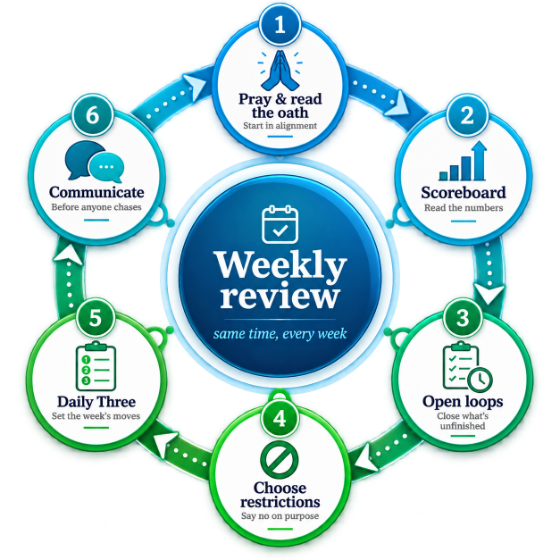
Same time, same order, every week. The meeting that keeps every other meeting honest.
The whole year on one page
A thirty-page plan is a way of avoiding a decision. One page forces you to say what actually matters, and one page is the only kind anybody re-reads in July.
Write it by hand, tape it where you work, and let it embarrass you in July. That is the whole mechanism.
The weekly review
The fortune is in the follow-up.
Most sellers say yes long after the first no, to the one who stayed steady.
The Deal Machine
A pipeline you can trust beats a hot streak you can’t repeat.

The basement that was failing
A clean-looking duplex, bought out of state. The photos were fine. The roof was fine. Down in the basement, the walls were bowing badly enough that they were on their way to caving in. That repair, plus the renovations that followed, was never in my original numbers.
Your reputation is underwritten on every deal, whether you priced it in or not.
Become someone people trust even when the news is not good. That is built through timely truth, not perfect circumstances.
The worst they can say is no
I was in Minneapolis on a work trip during my design years, courtside before tip-off, when I spotted one of the most famous billionaire investors in the world standing a few rows away. Everyone around me recognized him and did nothing. I walked straight up and hugged him like I was somebody he already knew, and he went right along with it. Hug, photo, handshake, done.
Ask. The worst outcome is that you end the day exactly where you already were.

The call that starts it all
Every deal begins with one human conversation, made on purpose.
The machine, not the mood
A pipeline is a promise to your future self: do the inputs today so the closings show up later.
You only control inputs, dials, doors, mailers, follow-ups. Control those and the outputs take care of themselves.
Consistency beats intensity. A steady machine outperforms a heroic week every time.
Measure activity, not just results, results are a lagging report card on last month’s discipline.
· Where does my pipeline actually break down?
· What input am I avoiding because it’s uncomfortable?
· What would 90 days of consistent activity produce?
Build your buy box
Decide what a deal looks like before you chase one, clarity is what makes speed safe.
The metros and trade areas you actually understand and can operate.
Storage, small multifamily, land, conversions, pick your lane.
The size range your capital and lenders can realistically close.
Turnkey, light value-add, or heavy, match it to your team.
The minimum spread that makes the risk worth it.
The red flags that get an automatic no, no matter how pretty.
Start where you already know something. Your job, your city, your trade: the edge you already own beats the market everyone is chasing. And let the deal pick the strategy: a property that pencils under two different uses gives you optionality, and optionality is worth paying for.
Where deals come from
No single channel is the answer. Stack a few, work them consistently, and track what converts.
Targeted lists, repeated touches, a simple call to action.
The fastest feedback loop between you and a motivated seller.
High volume, low cost, compliant, permission-based outreach.
Capture the seller already searching for a way out.
Distress you can see, neglected, vacant, tired properties.
Relationships that bring you deals before they hit the market.
Past sellers, attorneys, property managers, warm and cheap.
Rooms where owners and operators already gather.
Two signals I read before I call: days on market, because time is motivation made visible, and the plain listing everyone scrolls past, because most of my deals sat in plain sight, on market. My agent swore one seller would never take our number. We offered anyway. They took it. You have to ask.
Brokers are the second lane: buy box in two minutes, proof you can close, fast feedback on every deal including the passes, and never treat them as your free classroom. Feedback is the currency; the buyer who explains the pass gets the next first look.
Data and skip tracing
A great list beats a great pitch. Start with owners who have a reason to move, not just any address.
Skip trace to real humans, individual names and current numbers, not dead ends.
Prioritize distress signals: tax delinquency, code issues, long ownership, tired assets, out-of-area owners.
Clean data compounds. Garbage in means wasted dials, wasted mail, and a discouraged team.
· Is my list built on motivation or just availability?
· What signal best predicts a real conversation in my market?
· Who owns list quality on my team?
The cold-call mindset
You’re a problem-solver, not a telemarketer. You called because you might be able to help.
Detach from the outcome. Desperation leaks through the phone; calm curiosity opens doors.
Tonality carries more than the words. Slow down, warm up, and sound like someone worth trusting.
The first ten seconds buy the next ten minutes, be human, be brief, ask permission.
· Do I sound like help or like a pitch?
· What story am I telling myself before I dial?
· Where do my calls usually fall apart?
The seller conversation
Every good call walks the same arc, and the quoted lines are close to what I actually say. Rushing a step is how you lose the deal.
Skip a step and you get a price with no motivation behind it, which is just a number nobody has to honor.
We find deals, we do not manufacture them. Ask what is going on, then stay quiet and let them talk. Embrace no: the fastest path to a yes is refusing to chase the wrong seller.
The seller call, step by step
Talk twenty percent, listen eighty. Walk the arc in order and let the seller lead you to the deal.
Who you are, why you called, and a request for one minute.
Get a yes to keep talking before you dig in.
Open questions. Listen for the story under the story.
Condition, occupancy, what’s tired, what’s deferred.
Why sell, and why now? The real reason drives everything.
How soon do they need to move? Speed has value.
Explore the number in their head and the terms around it.
Say it back out loud and lock the next step.
The first call has one goal, and it is not a deal: it is to be remembered well. Sincere, curious, unhurried. Get the email and the cell, learn who else belongs in the decision, and open price gently: what number would you need, and is there any wiggle room in it? Money is usually the easiest piece once motivation, condition, and timeline are on the table. A no on the first call is normal. The relationship is the pipeline.
The four pillars of a lead
Qualify every seller against four things. Miss one and you’re guessing.
Why sell, and why now? The stronger the why, the more flexible the how.
What shape is it in? Repairs, occupancy, deferred maintenance.
How soon do they need to move? Speed has real value to some sellers.
What number is in their head, and what number actually works?
Ways to structure an offer
Price is only one lever. The right structure can solve a problem cash can’t, always know your exit and stay ethical and legal.
Speed and certainty in exchange for a discount. Simple and clean.
Pay over time when the seller wants income, not a lump sum.
Solve unique situations with flexible terms, educate yourself fully first.
Bring the seller along as a stakeholder when it fits both sides.
Whatever the structure, the close is a paperwork game: collect the full file up front (mortgage statement, insurance, HOA, rents, payoff), hire a transaction coordinator, follow title, and record everything with the county. Creative deals fall apart in the documents, not the idea.
Presenting the offer
The number is easy; the delivery is everything. Present with calm strength, then get out of the way.
Prove you listened before you propose anything.
Tie it to condition, speed, and certainty, not thin air.
What your offer removes from their plate, not your need for a yes.
Silence after the number is the whole game. Let them fill it.
If price stalls, move the terms. Solve the real problem.
Recap, send paperwork fast, confirm the date. Momentum closes.
Make the offer with calm strength
Anchor to value, not to your need for the yes. Pressure that comes from need is the pressure that kills deals.
Present the number as a range tied to condition, speed, and certainty, not a random low-ball.
After you name the number, be quiet. Silence does the work; the first to fill it usually concedes.
Summarize the agreement out loud before you end the call. No recap, no deal.
· Do I need this yes to prove something?
· Where could silence serve me better than another sentence?
· Is my number defensible in plain language?
“I want to think about it”
Usually there’s one unspoken concern, price, trust, or a spouse, hiding behind a polite delay.
The objection is rarely the obstacle. The unspoken concern is.
Acknowledge it, pressure now guarantees a no.
Isolate the real concern: “What specifically would you want to think through?”
Answer that one thing, then give them a clear, small next step.
Schedule the follow-up before you hang up, a vague “I’ll call you” is a lost lead.
“I’d rather not share my mortgage balance”
It’s a trust checkpoint. They’re asking, in code, why you need it and whether you’re safe.
The objection is rarely the obstacle. The unspoken concern is.
Reframe: you’re solving a problem together, not prying into their finances.
Explain why it helps, it lets you structure something that actually works for them.
Offer a range instead of a number if that’s easier to start.
Move on gracefully if they still won’t. Some information gaps end the deal, and that’s fine.
“Your offer is too low”
Often it means “convince me it’s worth it,” not “goodbye.” Stay in the conversation.
The objection is rarely the obstacle. The unspoken concern is.
Separate price from terms, a higher price on the right terms can beat a low cash number.
Educate calmly on condition, speed, and certainty, what your offer actually removes from their plate.
Find the number that matters to them, sometimes it’s smaller than the headline.
Hold your walk-away. A deal that only works at their number isn’t your deal.
Lead with the relationship
The first contact is a hello, not a pitch. Be a real person with a real reason for calling.
Give before you ask, a useful read on their market or a fair, honest take. Value earns the next conversation.
Ask about them and their store, then get quiet. People trust the person who is genuinely curious.
Follow up like a friend, not a funnel. Trust is the asset; the deal is the byproduct.
· Does my first touch feel human or transactional?
· What could I give before I ever ask?
· Who am I following up with as a person, not a lead?
Follow-up is the business
Most deals close after many touches, not the first call. The fortune really is in the follow-up.
Put every lead on a cadence, the machine remembers so you don’t have to.
Timing is everything and it’s theirs, not yours. Stay useful until their situation changes.
A polite, persistent, non-desperate follow-up is a competitive advantage almost no one keeps.
· Which past “no” is actually a “not yet”?
· Is my follow-up automated or dependent on memory?
· What would a 12-month nurture look like?
Underwrite before you offer
Fall in love with the numbers, not the property. The math is the guardrail.
What is it truly worth today, in this condition, in this market?
Repairs, holding, closing, and the surprises you haven’t found yet.
The spread that pays you for the risk and the work.
For holds, does the income cover the loan with room to spare?
Money set aside so one bad month isn’t a crisis.
Know how you get out before you get in.
Five gates, and any one can kill it
Most bad deals are not bought because the numbers worked. They are bought because nobody agreed in advance what would make them stop. Write the gates down before you fall in love with a property.
A gate you are willing to move is not a gate. Decide your no while you can still afford to say it.
Cold calling: the first twenty seconds
You earn the conversation in the opening. Be human, be clear, and ask before you dig.
Warm and unhurried. You called a person, not a lead.
Your real name, plainly. No script voice.
“I buy storage in the area and wanted to reach the owner.”
Permission lowers the guard and buys you the next minute.
Hand them the mic, then listen more than you talk.
Tone carries more than words. Slow down and sound like help.
A numbers game with a human center
It’s activity math: dials become contacts, contacts become conversations, conversations become leads. Protect the top of the funnel.
Most calls are a no, and that is fine. You’re mining for the few who are ready, so don’t take it personally.
Consistency beats cleverness. Same hours, every day, every outcome logged.
Leave value, not pressure. A short, warm voicemail and a real reason to call back.
· How many dials equal one real conversation for me?
· Where does rejection knock me off rhythm?
· Is my follow-up logged or lost?
What wholesaling actually is
You put a property under contract at a price that works, then assign that contract to an end buyer for a fee. You solve; you don’t always own.
The seller gets speed and certainty, the buyer gets a deal, and you earn the spread for finding and structuring it.
Done right it’s a real service. You’re the problem-solver in the middle, not a middleman skimming.
Keep it ethical and legal: be transparent, keep real buyers, honor your contracts, and follow your state’s rules.
· Am I solving a real problem or just flipping paper?
· Do I have real buyers before I sign?
· Am I transparent with every side of the table?
Assign or double-close
Two ways to get paid on a contract. Pick the one that fits the deal and the people in it.
Either way, say the fee out loud early. A spread that cannot survive daylight was never a deal.
From offer to close: due diligence
The offer is just the beginning. Verify everything before the money moves.
Terms in writing, earnest money set, dates defined.
Walk it; verify what you were told matches reality.
Clean title and real boundaries, no surprises.
Rent roll, delinquency, and expenses verified against the books.
Lender lined up, terms locked, appraisal ordered.
Coverage bound and ready the day you close.
Every date tracked so nothing quietly slips.
Funds, keys, systems, and tenants notified.
A report is a claim; a bank deposit is a fact. Reconcile one to the other before you believe either. Then photograph everything twice: the full view first, then the close-up of the problem.
The Wholesale Deal Sheet
Run every wholesale through the same math before you sign anything.
Know your exits
A deal is only as good as the way out. Decide the exit before the offer.
Pass a great contract to a buyer for a fee, speed, low capital.
Add value, then sell, bigger upside, bigger execution risk.
Keep it, run it well, let cash flow and NOI compound.
Sell on terms to widen the buyer pool and create income.
Bring capital or an operator when the deal is bigger than you.
The most profitable exit is sometimes the one you don’t take.
The deal funnel
Closings are a lagging result of everything upstream. Every ratio below is illustrative, but the shape is real: widen the top and the bottom takes care of itself.
The deal-machine scoreboard
Track the funnel, not just the wins. The numbers tell you where to fix the machine.
The raw activity that starts everything.
Real human contacts with decision-makers.
Motivated sellers worth an offer.
Numbers actually put in front of sellers.
Signed agreements in your pipeline.
The lagging result of everything upstream.
The deal analyzer
Run every deal through the same sheet before you fall in love with it.
You cannot scale yourself. You can only multiply yourself.
Documented systems and trusted people are how one builder becomes many.
The four pillars of a deal
Before you chase a property, qualify the seller. Four pillars have to stand, or the deal cannot carry weight.
A real reason beats any amount of polite interest. No motivation, no deal.
The work tells you the price and the plan. Surprises live here.
Urgency and certainty are worth real money to a seller.
Are expectations in the real world, or can you get them there?
Pull one pillar and the roof comes down. Three out of four is not a deal, it is a hobby with paperwork.
Motivation first, price last. Lead with price and you learn nothing you can use.
Know the exit before you enter
Every deal needs a way out planned before the money goes in. Hold the exits loosely, but never enter without one.
Pass the contract to a buyer for a fee. Lightest, fastest, no ownership.
Add value, then sell to the next owner at the higher number.
Keep it, run it well, and let the cash flow compound.
Sell on terms and collect the spread as the note pays down.
Bring in capital or an operator and share the upside.
The most underrated exit. A clean no protects every future yes.
The exit shapes the entry. Decide how you leave, and the right price to enter reveals itself.
The seller call, start to finish
A good call is not a pitch. It is a guided conversation that earns the right to the next step. Follow the arc.
Silence over explanation. Questions over pressure. Ego out of the room.
The first step is taking the first step. Clarity comes from moving, not from waiting to feel ready.
Objections are information
An objection is not a wall. It is the seller telling you where the real concern lives. Slow down and work it, do not bulldoze it.
"I need to think about it" usually means a concern went unspoken. Isolate the real one, then schedule the next step before you hang up.
"I will not share my numbers" is a trust checkpoint. Explain why it helps them, and offer to work in ranges until they are comfortable.
"Your offer is too low" separates price from terms. Educate on speed and certainty, and hold your walk-away without flinching.
The deal lives in the follow-up. Most sellers say yes long after the first no, to the person who stayed steady and kept in touch.
· Which objection do I handle worst, and why?
· Where do I talk past a concern instead of into it?
· What is my honest walk-away on this deal?
Building the Team
You can’t scale yourself. You can only multiply yourself.
The duplex we never stood in front of
A brick duplex, two units under one roof, a long flight from my desk. I never walked it. Neither did my partner. The whole thing ran out of state through a team of virtual assistants in the Philippines.
They pulled the list, skip traced it, made the calls, logged every disposition, and set the appointment. My partner and I qualified the seller on motivation, condition, timeline, and price, then structured the offer and carried the risk. Nobody needed to be in the room, or the state, or my time zone. They needed a recorded process, a scorecard, and someone who actually reviewed the work.
If you think you have to be local to do this, you are describing a staffing problem and calling it a geography problem.
saw it
from team

VA-run pipeline
The people who multiply you
You can’t scale yourself. A team turns one builder into many.
Your time is the constraint
Every venture eventually hits the same ceiling: the number of hours you personally have.
Sort your work by value. The $10 tasks are stealing the hours that belong to the $1,000 ones.
Delegate to elevate, hand off what others can do so you can do what only you can.
Leverage isn’t abandoning the work. It’s owning the outcome while multiplying the hands.
· What am I doing that someone else could do 80% as well?
· What only I can do, and am I protecting time for it?
· What would I build if I had my calendar back?
You do not have ten problems. You have one constraint, and nine symptoms of it. Find the single thing capping the whole system this quarter, put your weight there, and leave the rest alone until it moves.
The delegation ladder
Delegation isn’t dumping. It’s a process that transfers a result, not just a task.
Do it yourself until you understand it cold.
Capture the steps, a checklist or a screen recording.
Hand it off with the doc and a clear outcome.
Inspect what you expect until it is reliable.
Let the owner make it better than you did.
If it isn’t documented, you haven’t delegated it, you’ve just loaned it out. Hand over the task but keep the decision and you have only hired yourself a second job: transfer the outcome and the authority.
The goal is to become replaceable on purpose. Most of us quietly like being needed, being the fixer, being the last call. That is ego wearing a work shirt. You are a steward here, not the point, and a thing that only runs when you are in the room is not built yet.
Watch for superhero syndrome. The founder who has to touch everything becomes the cap on the whole company: every decision waits in one inbox, every hire stays junior, and productivity bends around one person’s calendar. Nobody who built anything big did it alone.
The ladder exists so you can take the cape off. Climb it one rung at a time and the business finally grows past your own two hands.
What to hand off first
Start with the repeatable, teachable, time-eating work, the tasks that drain hours without needing you.
Inbox, calendar, coordination, the constant low-value churn.
List building and clean-up that feeds the whole machine.
The high-volume top of the funnel.
Keeping every lead moving and nothing slipping.
Posting, mail merges, and content production.
Categorization and reporting, with the right controls.
The hiring system
Hire on a system, not a hunch. A repeatable process keeps you from hiring your own desperation.
Define before you attract. If you can’t describe the win, you can’t hire for it.
Hire slow and screen hard, the cost of the wrong person is paid for months.
Five steps: define the role, attract, screen, interview, onboard. Skip one and it shows.
· Am I hiring for an outcome or just for relief?
· What does winning in this seat look like in 90 days?
· Where have past hires actually gone wrong?
A contract calling somebody a contractor is evidence, not a defense. Classification follows how the work actually runs: who sets the hours, owns the tools, and directs the method. Ask your CPA.
Hire integrity over horsepower. A smart, energized hire without integrity costs you twice: once in the damage, once in the culture that watched it happen. Values fit outranks the resume, and one bad-fit yes undoes ten good ones. Recruit wider than your reflex; different backgrounds see problems your mirror image cannot. You can teach the skill. You cannot teach the character it rides on.
Step 1, Define the role and scorecard
Write outcomes, not chores. “Keep the pipeline full,” not “make calls.”
Name three to five measurable outcomes that define success in the seat.
Describe the person who thrives here, the traits, not just the skills.
A scorecard turns a vague job into a clear standard both of you can see.
· What are the three numbers this role owns?
· What kind of person actually enjoys this work?
· How will we both know it’s working?
Step 2, Write a job post that filters
Lead with outcomes and culture, not a wall of duties, attract the right, repel the wrong.
Bury one small instruction in the post to test who actually reads and follows.
Be honest about the hard parts. Clarity up front prevents turnover later.
Post where your kind of person already is, then let the filter do its job.
· Does my post attract A-players or just applicants?
· What instruction will reveal attention to detail?
· Am I honest about what this job demands?
Step 3, Screen with a self-video
Ask for a short self-recorded video before any live time. It saves hours and reveals a lot.
Screen for communication, energy, and the ability to follow simple instructions.
How they do the small thing, the video, is how they’ll do the job.
Shortlist only the few who clearly fit; protect your calendar for them.
· What do I need to see in two minutes of video?
· Who followed the instructions exactly?
· Whose energy would I want on a hard day?
Step 4, Interview to reveal, not to like
Likeable isn’t the same as capable. Use questions that surface how someone actually thinks and works.
The simplest tool, let them keep talking until the truth shows.
Process reveals competence; outcomes alone can be borrowed.
“Walk me through a time it went wrong.” Listen for ownership.
What they respect and resent tells you who they are.
Give a small real task. Watch, don’t just ask.
What they ask you reveals what they care about.
Step 5, Onboard with SOPs
Record the SOP once and reuse it forever, a library beats repeating yourself.
Give a 30-60-90 plan so the new hire knows what winning looks like early.
Engineer a first-week win to build momentum and confidence.
Pair them with someone; belonging is retention, and retention is leverage.
· What are the first three SOPs this role needs?
· What’s a realistic first-week win?
· Who is this person’s go-to?
Who does what on a lean team
You do not need an army. You need a few clear seats, each owning a number.
Four seats, four numbers. When a number slips, you know exactly which conversation to have.
The weekly team meeting
A short, predictable rhythm turns a group of hires into a team. Run the same agenda every week.
Start with what went right, momentum is a management tool.
Review the scoreboard together; let the data lead.
Surface what’s stuck and remove it.
Name the few things that matter this week.
Catch someone doing it right, out loud.
Everyone leaves with a clear, owned step.
Watch the tape together. Pull one real recorded call each week, listen to it as a team, and leave with a single change everyone commits to. Fix ten things at once and you fix nothing.
The cold-caller’s day
A caller with a clear SOP outperforms a talented one without. Same rhythm, every day.
Review targets and yesterday’s callbacks before dialing.
Protected calling windows, phone-only, no multitasking.
A daily dial and conversation target, tracked live.
CRM updated on the call, not from memory later.
Score each lead so the hot ones rise to the top.
Every open lead gets a next date, no exceptions.
Qualified leads routed to the closer fast.
Numbers in, wins and blockers noted for the meeting.
The standards that make a team
Culture is standards repeated. What you tolerate, you teach; what you celebrate, you multiply.
Clarity over charisma: people need to know what winning looks like today.
Standards without shame, name the gap, the impact, the expectation, the next action.
Own your number, communicate early, care in advance. Model it before you require it.
· What am I tolerating that I should not?
· Where is a standard unclear to my team?
· Am I modeling what I ask for?
People give their best where they feel valued, and that is behavior, not budget: compensate fairly, flex when life happens, listen before deciding, say thank you specifically, keep expectations reasonable, and teach the job well the first time so nobody is punished for your missing manual. Stressed, disengaged teams quit twice, first in effort and then in fact, and turnover is the most expensive line item you never see on a P&L.
Culture in five moves: tell the story, ask before telling, build leaders under you, treat failure as tuition, and hold each other accountable, partners included.
Manage with cadence and care
Rhythm beats intensity in management too: a daily check-in, a weekly meeting, a monthly one-on-one.
Every role owns a number, and the number is visible. People rise to what they can see.
Correct with standards, not shame, name the gap, the impact, the expectation, the next action.
Care in advance: train before you’re frustrated, clarify before you’re disappointed.
· Which role is missing a clear number?
· Where am I frustrated when I should have trained?
· What rhythm would make my team self-correcting?
Communication is a performance standard, not a personality trait. Answer fast, answer clearly, and send the update before you are asked. A quiet teammate reads as a struggling one, whether or not it is true.
A KPI is a scoreboard, not surveillance. One visible number per role tells every person on the team what winning means today, which is another way of giving them purpose. Review the number on a rhythm, praise in public, correct in private, and let the team see leadership held to numbers too. People do not burn out from high standards; they burn out from invisible ones that move.
Good people, treated well, reading a fair scoreboard: that is the whole machine. Everything else is decoration.
The role scorecard
Fill one out before you hire, it becomes the job post, the review, and the standard.
Most wins are not dramatic. They are maintenance done faithfully.
The gate works. The report goes out. The rate is adjusted. That is compounding.
Manage with cadence, not crisis
A team drifts without rhythm. Set the beats and standards hold themselves, without you hovering.
A short pulse: what is the one priority, what is in the way.
Review the scoreboard, close loops, set the week ahead.
Coaching and growth, away from the day-to-day noise.
Re-aim goals, re-balance focus, celebrate what worked.
Every role gets one visible number. Standards without shame, repeated until they are culture.
Cadence is what replaces you. Daily check-ins catch problems while they are small, the weekly meeting holds the scoreboard, the monthly one-on-one grows the person, and the quarterly review resets the plan. Miss the rhythm and you go back to being the answer to every question.
The hiring system, five steps
Hiring is transferring trust. A system keeps you from falling for a good talker and missing a great worker.
A scorecard of outcomes, not a vague list of tasks.
Write the ad to screen people out. Hide one instruction to catch who reads.
A short recorded answer tells you more than a resume ever will.
"Tell me more." "How did you do it?" Then a small live task.
Recorded SOPs and a 30-60-90 so day one is not chaos.
Capacity and character first. Skills you can teach; humility you mostly cannot.
The first ninety days
A new hire either learns your standard in the first ninety days or drifts from it. Make the path obvious.
Absorb the SOPs, the tools, and the standard. Shadow, then do with a net.
Run the core role solo, owning the one number that defines it.
Not just doing the job, but improving how it is done. Suggest the next SOP.
The Operator’s Playbooks
Vision gets the deal. Operations keeps it.
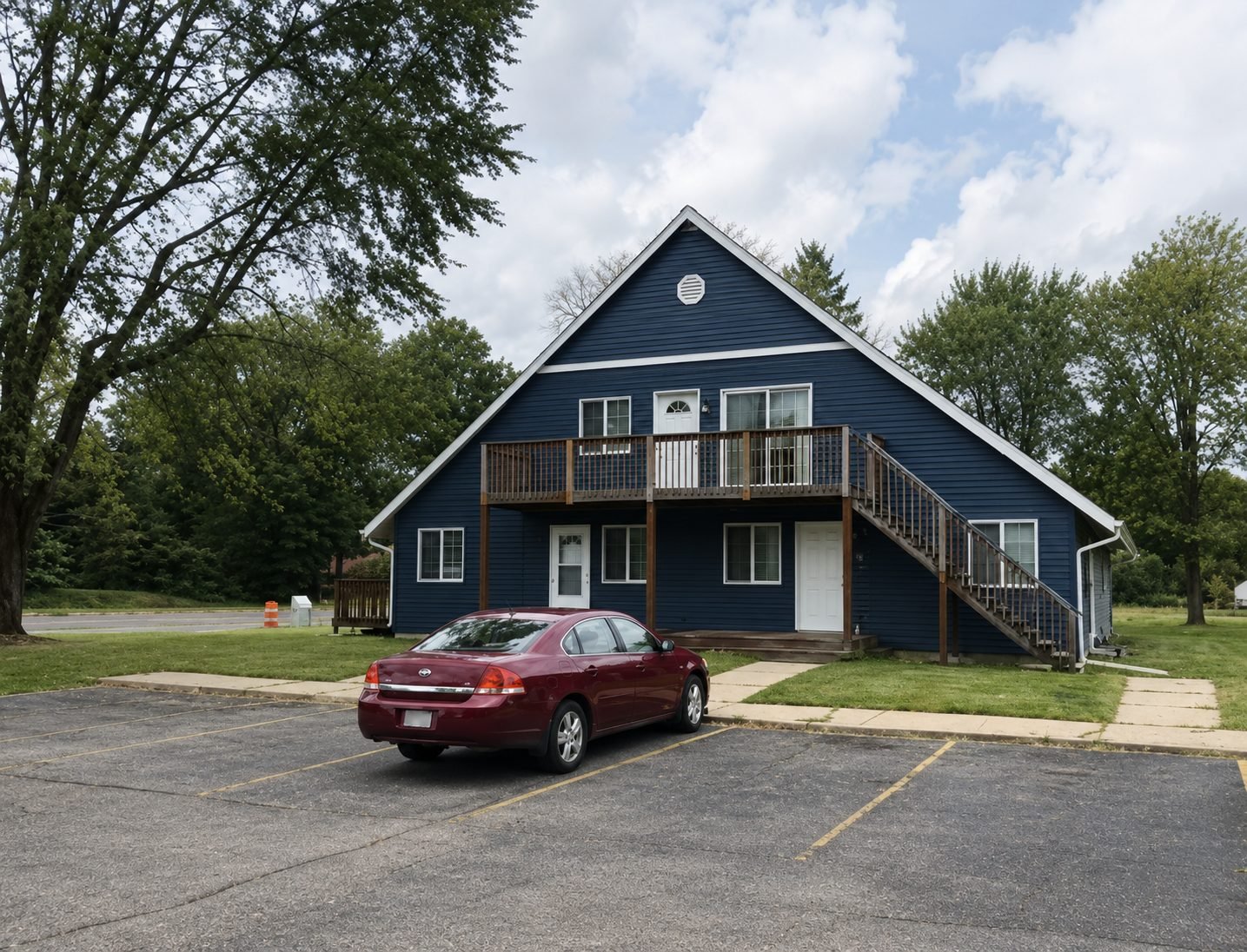
Held, repaired, exited
Three triplexes and a kitchen fire
Nine units across three buildings, side by side by side, bought and run entirely out of state with a partner and outside investors. Then one of them caught fire in the kitchen.
Adjacency is leverage: three buildings in a row share one crew, one manager, one drive, one set of systems.
The first storage facility
Gravel drive, cinder block, blue roll-up doors, and a rent roll that had not been touched in years. It was not glamorous, and that was exactly the point. Nobody was fighting me for it.
Boring assets with sloppy operations are where a systems person gets paid.
This is where I fell for storage for good: demand arrives on its own, nobody lives inside the unit, and systems force the value. I also did not do it alone. You want a partner who is not a copy of you, but a completion of you.
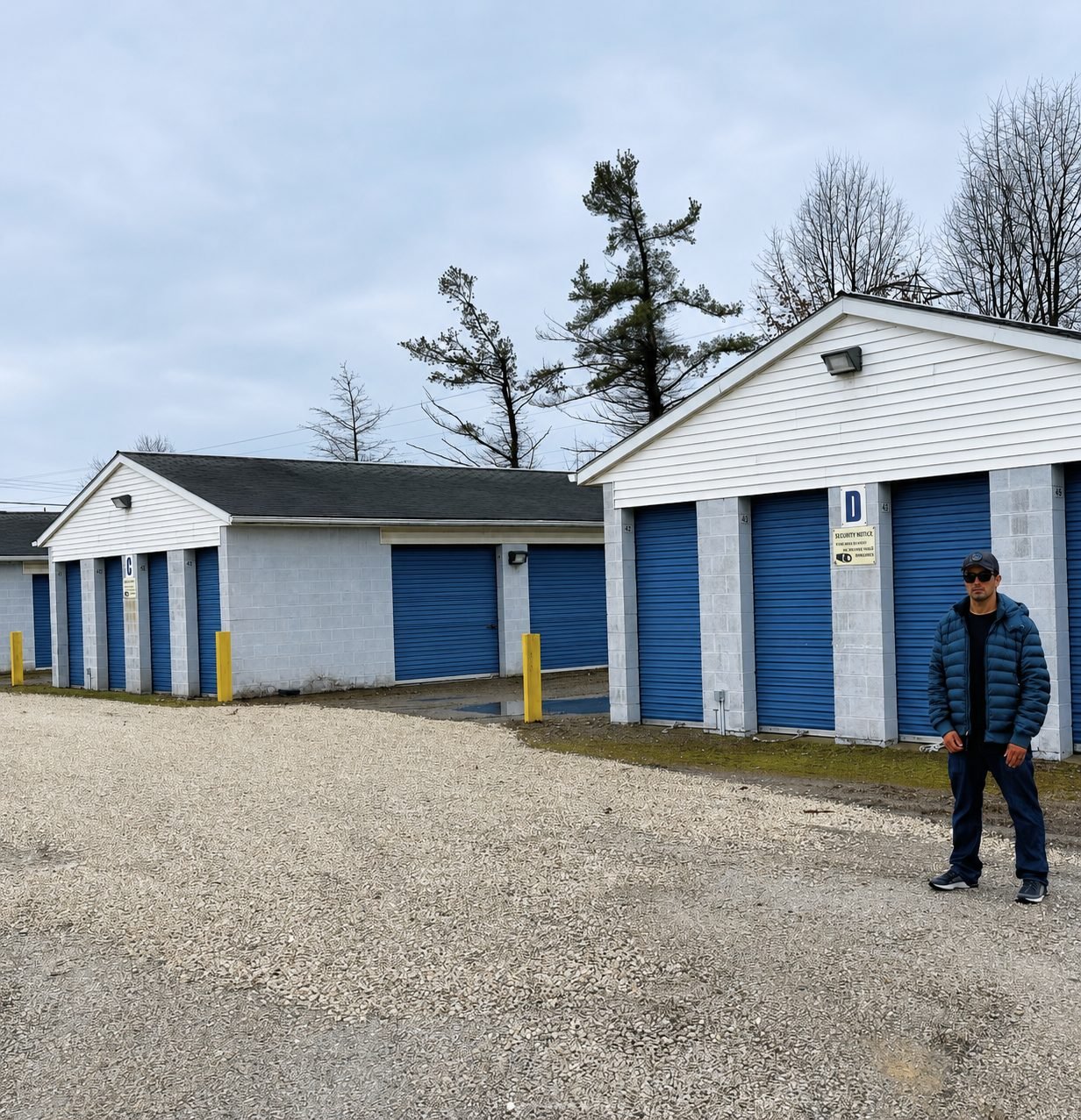
The work itself
Boring excellence, repeated: clean units, working gates, a report that goes out on time.
Storage: the revenue-management playbook
Price the street rate to live demand, up when you’re tight, sharper when you’re soft. A static rate board leaves money on the table every month; flex it by unit size, season, and occupancy, because guessing is the one pricing strategy that always loses.
Run the existing-customer rate increase on a set cadence. In-place tenants rarely move over a fair bump, and it compounds into real NOI.
Protect economic occupancy, not just physical. A unit full at a permanent discount is a vanity metric.
Watch revenue per available square foot as the one number that ties rate and occupancy together.
· Is my rate board reacting to demand or frozen?
· When did I last run an in-place increase?
· Am I chasing “full” or chasing earning?
Storage: the monthly operating checklist
Run it every month, consistency is the whole edge in a business this simple.
Gate, cameras, lighting, and locks all working and logged.
Vacants clean, swept, and rent-ready, no dead inventory.
Street rates and in-place increases reviewed against demand.
Late process run on schedule; auctions as a last, clean resort.
Ask happy tenants; respond to every review, good or bad.
Local search, map listing, and website accurate and live.
Every call answered or returned fast, a missed call is a lost rental.
Occupancy, rate, delinquency, and NOI to the owner, on time.
Add to the list: read your signage from the road like a stranger would, audit your Google profile and website like a customer trying to rent at 9pm, confirm autopay enrollment and card-expiry cleanup, and check that every missed call got answered by something. Most of this can run on AI now, and mine does. Ask me how I wired it; the same stack I run is the one I teach.
Fill it, then price it
Occupancy is a funnel: inquiries → reservations → move-ins, and always move-outs. Manage every stage, not just the sign out front.
Discounts are a scalpel, not a faucet. Use a first-month concession to win a tenant, then let the real rate take over.
Move-outs are data. If people leave after the first increase, your onboarding or service, not your price, is the problem.
Chase the tenant who stays. Occupancy that churns is just expensive motion.
Roughly eight in ten operators now put automation first. The stack routes care to where a human actually matters.
Storage: the acquisition checklist
Before you buy, drive the ring and audit the truth. Value you can verify beats a pretty pro-forma.
Population, income, and rooftops within a few miles.
Competitors open, under construction, and entitled.
Street rates nearby vs the subject, real upside or wishful?
Rent roll, aging, and what the books don’t show.
Taxes, insurance, payroll, and deferred maintenance.
Exactly which levers you’ll pull to grow NOI.
One more thing the mom-and-pop P&L will hide: the expenses the seller never carried. Underwrite bad debt, management at market cost even if you plan to self-manage, landscaping and snow, real advertising, honest capex, and property taxes reassessed at your purchase price rather than their decades-old bill. If the expense ratio looks like a gift, it is. Rebuild it line by line.
Reading a rent roll line by line
A rent roll is a sales document until you make it a source document. Every line is a claim, and every claim has a place it can be verified. This is the order I read one in.
Underline every number you cannot tie to a bank statement or a signed lease. That list is your negotiation.
Touch it before you buy it
Photographs are marketing. A walk is diligence. I do not care how far the flight is, somebody I trust puts hands on the asset before money moves.
If nobody has stood on it, you are not buying an asset. You are buying a spreadsheet with an address.
If it is not recorded, you do not have it
The most expensive surprises I have seen in storage were never about the buildings. They were about access. A gate somebody else owns. A driveway that crosses a neighbor. A well nobody has papers for. Handshakes do not survive a closing.
Ask one question about every right the property depends on: show me where that is recorded. If nobody can, price the risk or walk.
Add to the search: easements and access rights, encroachments on the survey, unrecorded leases and side agreements, mineral and water rights, HOA or CC&R restrictions, code violations and open permits, deferred assessments, and any lien that survives a sale. If it is not recorded, it is a promise. If it is recorded, it is a fact. Underwrite facts.
The coverage nobody reads until they need it
Underinsurance is the quietest way to lose a building. Nobody notices until the claim, and by then the conversation is over. Read the policy once, carefully, before you need it.
Insurance is not an expense line to minimize. It is the reason one bad night does not end twenty years of work.
The NOI lever almost nobody pulls
Taxes are usually the largest line you can actually argue with. Most owners pay the assessment and complain about it. The appeal is a form, a deadline, and evidence.
A successful appeal lowers an expense permanently, and a permanently lower expense raises the value of the building forever.
Storage: targets worth watching
Illustrative operator targets; set your own by market and season, then hold the line.
Numbers are illustrative benchmarks · calibrate to your own facility.
More grounds worth filing on: an assessment above your actual purchase price, comparable sales the assessor missed, square footage or unit-count errors on the record card, deferred maintenance that impairs value, occupancy well below market, and an income approach that ignores your real expenses. Appeals are boring, annual, and among the highest-return hours in this business. Every dollar of tax you remove is NOI you keep forever.
Lagging numbers judge you. Leading numbers coach you.
The scoreboard tells you where you have been. The steering wheel decides where you go next quarter. Manage the week by the leading numbers and the lagging ones follow.
You cannot manage a result. You can only manage the behaviors that cause it.
Five ways to find storage deals
Deals are hunted, not stumbled into. Run all five channels and the pipeline never runs dry.
Hunt where the giants don’t bother to look.
Find the tired mom-and-pop stores hiding in plain sight.
Work stale listings and, more importantly, the brokers behind them.
Owner groups and associations where deals get whispered first.
Direct mail and cold calls still reach the owners who never list. Slow, unglamorous, and the reason my best stores were never on a broker’s sheet.
Pick the right storage market
My small-market filter, big enough to need storage, small enough that the institutions ignore it.
Draw the trade area before you compute the ratio: boundaries are behavioral, not circles on a map. Drive every approach, mystery-shop every competitor by unit type, and use rentable square feet, never gross building area. Supply per capita screens a market; it cannot make the decision for you.
Mine the map for mom-and-pops
Open the map, search storage near a target town, and read the tells. Under-management is your upside.
An owner not online is an owner not optimizing, room to grow.
A site that can’t take an online payment is leaving money and tenants behind.
Neglected listings usually mean a neglected P&L.
Low ratings signal service gaps you can fix on day one.
The best sellers are worn out, not desperate, meet them with respect.
Every gap is value you install, not value you overpay for.
Work the listings, win the brokers
Scan the listing marketplaces for storage that has sat too long, months on market is motivation wearing a for-sale sign.
Make clean, respectful offers on stale listings at volume; courtesy plus consistency gets you remembered.
The real edge isn’t the listing, it’s the broker. Get known by the storage brokers and earn a seat on the off-market call before it ever becomes a listing.
Be the buyer who closes and communicates. Brokers bring deals to the people who make them look good.
· Which listings in my market have gone quiet?
· Which brokers don’t know my name yet?
· What makes me an easy buyer to work with?
Mail and call, consistently
Direct mail is cheap, automatable, and has shelf life. Personalize it, keep it short, say what’s in it for them, and send it week after week.
Cold calling is a numbers game with a human center: keep it simple, be yourself, say who you are and why you called.
Ask open questions and let the owner talk. Lead with the relationship, not the price, the offer lands after the trust.
Cadence beats bursts. A steady weekly rhythm of letters and calls fills a pipeline that randomness never will.
· Is my outreach personal or generic?
· Am I leading with relationship or with a number?
· What weekly cadence can I actually keep?
Build Your Storage 100 List
A living list of a hundred target facilities and the owners open to a conversation. Add 15–25 a week; send about 25 letters and call five owners a day.
The facility upkeep standard
Clean signals cared-for; cared-for rents and holds rate. Walk it like a customer would.
Access, cameras, lighting, and locks working and logged.
Vacants swept, doors rolling, latches clean.
Trash, weeds, and debris cleared; drive lanes clear.
Bright, legible, and inviting from the street.
Clean, stocked, and professional for every walk-in.
Eyes on every row; small issues fixed before they grow.
Note what needs repair and who owns it, by when.
A set daily and weekly rhythm, not a scramble before a visit.
Your first 90 days in storage
A quick-start path from zero to your first offer. Simple, sequenced, and repeatable.
Run the small-market filter and choose one place to hunt.
Mine the map for mom-and-pops; add 15–25 a week.
Mail and call on a weekly cadence, relationship first.
On live leads, verify demand, supply, rate, and expenses.
Respectful, structured offers tied to value and certainty.
Line up capital, close one, install systems, pull the levers.
Also in the first ninety: walk and photograph every unit against the ledger, change every lock and password, reconcile collections to bank statements rather than reports, put delinquency into a lawful and consistent process, stand up the daily dashboard, rebuild the website and Google profile, enroll autopay, set street rates by unit type, start the review engine, and write the twelve-month capital plan before the quarter closes. Ninety days is enough to install a system. It is not enough to install a habit, so document everything as you go.
Restaurants: run the prime cost
Prime cost, food and labor together, is the number that makes or breaks a restaurant. Know it weekly, not at tax time.
Run a daily flash: sales, covers, labor, and waste. Small leaks sink tight-margin ships.
Every recurring problem is a missing SOP. Turn the fix into a checklist so it never comes back.
A location is a laboratory: what you learn here becomes a system, a training, or an offer.
· Do I know last week’s prime cost?
· What waste is hiding in plain sight?
· Which fire could become a permanent fix?
Read it weekly, not monthly: food cost by category, labor as a percent of sales, waste, comps and voids, ticket times, covers, and average check. Prime cost is food plus labor, and it is the one number that tells you whether the kitchen is a business or a hobby. A restaurant reports before midnight. Use that; almost nothing else you own will.
Restaurants: the daily operating rhythm
The same rhythm every shift, what gets checked gets done.
Staffing matched to the forecast, adjusted through the day.
Line stocked, temps logged, stations set before doors open.
Logged and reviewed; patterns become training.
Speed and accuracy tracked, the guest feels every minute.
Cash, cleanliness, and tomorrow’s prep set up tonight.
Tables touched, issues fixed before they become reviews.
Underwriting: the numbers that decide
Start with NOI, real income minus real, fully-reserved expenses. Optimism is not an expense line.
Cap rate turns NOI into value; stress it both ways so a small miss doesn’t erase the deal.
For holds, debt-service coverage is the seatbelt, income must clear the loan with room to spare.
Reserve for the roof, the paving, and the surprise. The deals that hurt are the ones that skipped reserves.
· Is my NOI honest or hopeful?
· What happens to value if the cap rate moves against me?
· Where am I under-reserved?
Also decisive: economic occupancy against physical, expense ratio against market, breakeven occupancy, replacement reserves per unit or per square foot, debt yield, and the exit cap you are willing to defend in writing. Six numbers stop most bad deals. The seventh, your walk-away price, stops the rest.
AI tooling: build vs buy
Most owners over-build. Sell the painful problem first; automate the proven workflow second.
Ten full-time callers in the Philippines became one AI agent I built and now offer to other operators. A person still owns the outcome and reads the transcripts.
Never paste tenant, investor, or legal data into a tool you have not vetted. Prompts are job descriptions: name the role, fence the sources, state the decision you need.
Lead scoring, call summaries, review replies, and first-draft SOPs. Anything that touches money or a promise gets a human before it ships.
AI: automate the proven, keep a human in the loop
Automate the repetitive and rules-based first: call summaries, lead scoring, follow-up drafting, reporting.
This is not theory for me. The cold-calling seat that once took ten full-time people in the Philippines now runs on my own AI calling agent, with a human stepping in the moment a seller is real. Automate the proven motion, never the judgment.
Never automate a broken process, you only make the breakage faster and permanent.
Keep a human wherever trust, money, or judgment is at stake. AI drafts; people decide.
Measure the win in hours saved and errors avoided, not in how clever the tool sounds.
· What repetitive task eats my team’s week?
· What must a human always approve?
· Where would automation embarrass me if it ran alone?
Where the machine stops and you sign
Everyone is racing to hand work to AI. Almost nobody writes down where it must stop. That list is the difference between leverage and liability, and it is the cheapest insurance you will ever write.
Never hide that a caller is automated, and never let a machine deliver news that deserves a human voice. Speed is not worth your name.
Write the standard before you meet the applicant
Every bad tenant I have had, I let in by making an exception. Write the criteria down while nothing is on the line, then apply them the same way to everyone. That is both good business and the law.
The best eviction is the one you prevented at the application. Slow down at the front door and the back door stays closed.
When to fire a property manager
Changing managers is disruptive and expensive, which is exactly why owners wait too long. Here is the line I use, so the decision is made before I am emotional about it.
Give one clear warning with a date attached. If nothing changes by the date, act. Standards without consequences are wishes.
A prompt is a job description, not a wish
Most people type a question and get a paragraph of confident nonsense. The fix is not a better model. It is telling the machine what job it holds, what it may read, what standard to decide by, and what to do when it does not know.
And never paste investor, tenant, employee, or legal data into an unapproved system. Convenience is not a defense.
Three prompts I actually keep
Not clever ones. Boring, specific, reusable. Replace the brackets, attach the real documents, and read the output like you would read a junior analyst’s first draft, which is exactly what it is.
Every one of these ends the same way in practice: a human reads it against the source documents before anybody acts on it.
The facility turnaround plan
Pick one asset. Name the levers, the owner, and the date, then go pull them.
Run it like an institution
Great management is where the returns actually live. Three disciplines, six habits that separate an operator from a landlord.
Standardize the routine work so it runs the same way every time.
Watch the margin, not just the revenue. Every line item is a decision.
Build systems that survive a bad month and a key person leaving.
Maintain on a schedule so small problems never become big bills.
Easy to rent, easy to stay. Retention is cheaper than acquisition.
Numbers out on time, every time. Nobody should chase the truth.
Boring, repeated, on time. That is what compounding looks like in operations.
Ways people invest together
You do not have to do it alone, or all at once. These are the common shapes capital takes when people build together.
A few people, complementary strengths, one deal at a time.
Active co-operators splitting the roles and the upside.
One sponsor, many passive investors behind a larger asset.
Pooled capital deployed across several deals to a strategy.
Start where you fit today. You can climb from passive check to lead sponsor as you learn.
The industry at a glance
A big industry still owned one store at a time. Roughly two of every three facilities are run by independent operators, many near retirement, and that is the whole opening. Figures rounded, illustrative.

Big industry, fragmented ownership, aging sellers: buy well before the institutions buy them all.
Read the four this way. Institutional owners bring cheap capital and brand but move slowly. Regional operators have real systems and are the most common seller of a good store. Small multi-store owners are where professional management creates the fastest value. Single-store independents hold the deepest upside and the messiest books. The further right you go, the more the value comes from you rather than the market.
The three demand-capture channels
Almost every storage renter finds you one of three ways. Win all three and the units fill themselves.
The storefront that never closes. It must load fast, show price and availability, and let anyone rent online in minutes.
The fastest tap to turn on. Paid search puts you in front of someone searching to rent right now.
The compounding one. A strong Google Business Profile and local pages earn the free clicks for years.
Never miss the call at the end of any of them. A missed call is a unit rented at the competitor.
Everything above is digital demand capture: search, maps, website, calls. It is where most storage demand actually starts. Offline still earns its keep though, especially in small markets: postcards to a tight radius, door knocking the businesses nearby, and plain outbound calling to contractors, movers, and property managers. Digital catches the demand that already exists. Offline creates the demand nobody has asked for yet.
The occupancy flywheel
Storage growth compounds in a loop. Each turn makes the next one easier, until the wheel spins on its own.
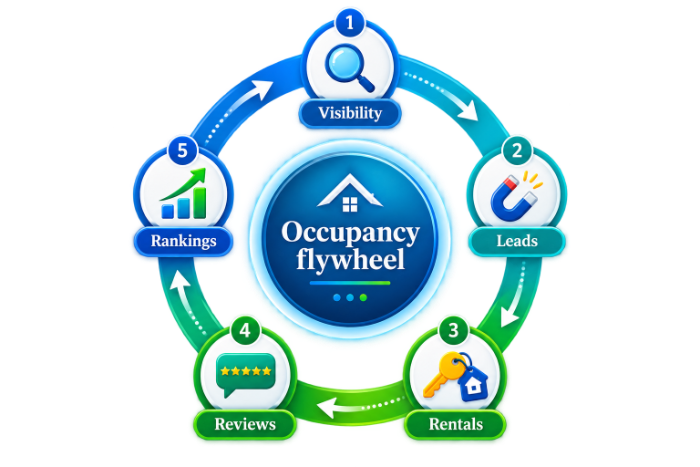
Visibility earns leads, leads become rentals, rentals become reviews, reviews buy rankings, and rankings compound visibility.
The storage marketing funnel
Every renter moves down the same five steps. Widen the top, and tighten every drop-off in between.
You do not have a traffic problem or a rate problem until you know which step is leaking.
Fifteen levers from 80% to full
Most facilities plateau between 75 and 85 percent. Full occupancy comes from stacking small operational levers, not one big push.
Match sizes to what the market actually rents.
Businesses rent long, and rent more than one.
Turnover next door is a steady referral pipe.
Meet the customer at the moment of need.
Fill the slow months with summer demand.
Tools and materials rent year-round.
Turn happy tenants into your sales team.
Stagers, agents, and estate sales send renters.
Let them rent in minutes, not office hours.
Automate the ask right after move-in.
Pages for the neighborhoods you serve.
Add units where the land already sits.
A saved move-out is a free move-in.
Charge more for the easy-access units.
Local presence reinforces the brand.
No single lever fills a facility. Pull several at once and they compound.
The operator dashboard
What you do not measure, you cannot manage. These are the numbers a storage operator reads every month.
Units filled, the headline number.
Revenue collected vs potential.
Revenue per available square foot.
The in-place rate you are earning.
New tenants this month.
Departures, and why they left.
Calls, clicks, and reservations.
Leads that became move-ins.
Read them monthly, act on them weekly. The dashboard is where drift shows up first.
The storage acquisition framework
Underwrite in three passes. A yes has to survive all three, in order, before it earns an offer.
The best upside hides in operational inefficiency, not in a hot market.
Diagnosing an underperforming facility
Most tired stores fail in the same three places. Walk the lens in order and the fix reveals itself.
Fix the systems, not the symptoms. Occupancy follows a well-run store.
The modern storage tech stack
Technology should erase repetitive work and give you one clear view across every property. Augment the operator, never replace the judgment. And choose results, not a name; the biggest logo often ships the oldest workflow.
The system of record: units, tenants, billing, reporting.
Every lead and seller tracked, nothing falling through.
Know which channel earned the call, and never miss one.
Email and SMS sequences that run without you.
Answer, qualify, and follow up around the clock.
One live view of the numbers across the portfolio.
A shared sheet used daily beats an elegant platform nobody opens.
The Operator’s Day
Energy, focus, and the daily practices. How three intentional days fit inside one calendar day, why five focused twenties beat one perfect hundred, and the rituals that protect the machine that runs it all: you.
Success is not a wake-up time
Protecting your energy, directing your attention, and repeatedly completing the right work beats any four in the morning alarm.
Celebrity routines are examples, not laws. Build the day around your responsibilities, your health, and your family, then defend it.
Teaching in public belongs in the operator’s day. My podcast is not marketing bolted onto the business; it is the business developing in the open, and every episode compounds into deal flow, capital, partners, and accountability. You do not need millions of listeners, you need the two hundred right people in your niche hearing you think out loud every week, and guesting on other shows multiplies that network for free. The microphone is a cold call ten thousand sellers can answer.
One calendar day, three days lived
Divide the day into intentional performance blocks and each block becomes its own day, with its own objective. Thirty days on the calendar, ninety days of focused living.
Not three eight-hour shifts, and never at the cost of sleep. Blocks of sixty to one hundred twenty minutes inside a protected window, with rest and transitions between them.
Build: the strongest hours on the biggest lever
Your best mental window goes to the work with the greatest financial or strategic leverage. One block, one outcome, nothing else open.
Do the most important work before routine communication. The inbox is other people’s priorities arriving on your schedule.
Expand: the second venture gets its own day
The afternoon block belongs to whatever you are building next, so the future stops competing with the present for the same hours.
Two focused twenties in one day is how jobs get stacked and companies get run in parallel without anyone getting cheated.
Day Two is where most people quit, because the first lane is finally comfortable and the second one is awkward again. Expand only after the first lane runs without you for two full weeks. Comfort is the signal to add a lane, not to coast in the one you have.
Live: the block that pays for the other two
Reserve a real part of every day for the reasons you want success in the first place. Scheduled, protected, and never apologized for.
This block is not spare capacity. It protects the energy, the relationships, and the purpose the first two days run on.
Day Three is the one nobody protects. Put it on the calendar first, in ink, and let the other two days fill in around it: faith, family, health, the people who count on you, and the things you would do for free. If Day Three keeps losing, you did not build a system. You built a nicer job.
One life, five allocations
Instead of spending all of your capacity perfecting one outcome, allocate five focused twenties. Each earns an outcome around eighty percent of the theoretical maximum, and the mission only ever needed the eighty.
| Allocation | Where it points | What it buys |
|---|---|---|
| 20% | Primary business | Growth and income |
| 20% | Investments or the second venture | Wealth creation |
| 20% | Content, education, a personal project | Influence and fulfillment |
| 20% | Health, faith, and recovery | Energy and longevity |
| 20% | Children, relationships, and travel | A life worth the work |
Life portfolio diversification: no single part of your life has to carry your whole identity, income, and sense of accomplishment.
Treat your life like a portfolio and rebalance it out loud, on paper, once a quarter: which lane is overweight, which one is starving, and what one honest trade would fix it. Nobody drifts into balance. You allocate it the same way you allocate money.
What the math does and does not say
Five eighty percent outcomes are not one perfect hundred. They are five separate outcomes in five separate areas, and that is the point.
The essential question: what is the smallest amount of focused, high-quality effort that produces an outcome good enough to accomplish the mission?
And this is a menu, not an assignment. Five is the ceiling the math allows, not a quota you owe anyone. Run two lanes deeply, or three, and pour the rest into faith, family, health, or the thing you are simply curious about. The point is that the ceiling is higher than one. What you put in those lanes is entirely yours.
The eighty percent completion rule
For reversible, noncritical work, drive to the point where the outcome is ready, then release it and let reality give the feedback.
Then release, delegate, publish, submit, or move forward. Improve the remaining twenty percent after real feedback arrives, because perfectionism loves to dress up as productivity.
Irreversible or high-stakes decisions get the full diligence, every time:
Reversible decisions deserve speed. Irreversible ones deserve patience. Knowing which is which is the whole skill.
This is the most misused idea I teach. Passable is a strategy, not an excuse. There are places where eighty percent is plenty: a good-enough email, a clean-enough listing photo, a solid-enough first draft. And there are places where eighty percent is negligence. Guardrail: never eighty percent on safety, money handling, legal filings, contracts, or how you treat people. Those get one hundred, every time.
Morning: take the day before it takes you
At 8:30, at my desk, I will work on the investor file for ninety minutes. That sentence gets more done than any app.
Workday: turn attention into output
One purposeful interaction a day with a child, a teammate, an investor, or a mentor. Success that costs every relationship is not success.
Evening: close the loops, protect tomorrow
Gratitude and grief live in the same room. Let them both stay.
You do not have to finish grieving before you are allowed to be grateful.
Start with five, for thirty days
Do not attempt all twenty at once. Five keystone practices build the foundation, and the rest layer on without becoming another project.
I do not accept that one calendar day equals one productive day. I divide my time into intentional blocks and live as many as three days inside every one: a day to build, a day to expand, and a day to live. I point each block at the small share of work that creates most of the result, and when eighty percent fully accomplishes the mission I ship it and move. I am not trying to work every waking hour. I focus hard, recover on purpose, and build a life I actually have time to enjoy.
Faith, Family & Self
Faith first. Family always. Freedom as the fruit.
Look for what did go right
Optimism is not a personality type. It is a discipline, and it is trainable. In the worst year I can remember, the good was there the whole time. I just had to go looking for it on purpose.

Where I go to get quiet
I am a backpacker, a scuba diver, a kayaker, and someone who will get on a plane for a trail I have not walked. Japan is my favorite country on earth. British Columbia is where I keep going back.
None of this is a reward for finishing the work. It is part of the system. Never leave the desk long enough, and you start mistaking the desk for your life.
What the freedom is actually for
Every framework in this book exists to buy back time. If you win the time and never spend it on anything that makes you feel alive, you did not build freedom. You built a nicer treadmill.








Nixon and Nova
My two huskies. They do not care about the pipeline, the rent roll, or what closed this week. They care that it is time to go outside, and they are right about that more often than I am.


Huskies do not let you skip the walk. That daily, non-negotiable hour outside has done more for my thinking than any productivity app I have ever installed.
Build a life with something in it that will not let you stay at the desk.
The people it’s all for
Faith first, family always. The reason underneath the work.
Faith as the operating system
Faith isn’t a compartment of my life; it’s the operating system the rest of it runs on.
It shows up as behavior under pressure, how I treat people when the deal is dying, not just on Sunday.
Surrender the outcome, own the responsibility. I do the work and release the result.
A faith that never costs a decision isn’t governing anything. Let it decide something real this week.
· Where is my faith a compartment instead of the core?
· What would faith govern in my hardest situation right now?
· What am I gripping that I need to release?
A practice that survives a hard week
Build a daily rhythm short enough to actually do and strong enough to change your state.
Gratitude resets perspective; confession clears the deck; surrender releases the grip.
Feed on something true before you feed on the feed, scripture or wisdom before the phone.
Name one act of service for the day. Faith becomes real the moment it leaves your own head.
· What is my non-negotiable daily practice?
· What do I consume first each morning?
· Who can I serve today, specifically?
Rest is a strategy, not a reward
Sabbath isn’t laziness; it’s the discipline of trusting that the world holds without me for a day.
A rhythm of rest protects the judgment every other decision depends on.
Rest is where perspective returns and grinding blindness lifts.
Guard one day, one evening, one morning, and defend it like it’s a client meeting, because it matters more.
· When do I actually stop?
· What breaks when I never rest?
· Which block of rest will I defend this week?
Your body is the equipment, not the afterthought
I ran mine into the ground for years and called it commitment. Every framework in this book runs on one machine, and if you will not maintain it, none of the rest of this is available to you.
I am not the model of health. I am the guy who paid for ignoring it, and I am telling you the bill comes to everyone eventually.
Heat, sweat, and ten quiet minutes
A sauna session paired with stillness has done more for my head than most of the advice I have paid for. The heat empties the body and the quiet empties the noise, and you come out of it able to think again.
For me the quiet is prayer, and I will always say so. But stillness is not owned by any one faith, and you do not have to share mine to receive what it gives.
Money, generosity & contentment
Money is a tool and a test, not a scoreboard for my worth.
Give first and on purpose. Generosity keeps money from becoming the master.
Contentment is a skill: gratitude for enough while I build for more.
Steward every dollar, earn it honestly, spend it wisely, give it freely, invest it patiently.
· Is money my tool or my identity?
· Where has more never felt like enough?
· What am I giving on purpose?
Your personal board of advisors
No one builds well alone. Assemble the few voices who tell you the truth with love.
Someone a few steps ahead who’s walked the road.
A builder in the arena who gets the daily weight.
A professional for the inner work you can’t coach yourself through.
Someone who calls you up to your calling.
Clear eyes on the numbers and the risk.
The friend who loves you enough to say the hard thing.
You are the sum of the five people you spend the most time with, so choose them like investments, and choose the closest seat with the most care. Napoleon Hill gave that seat a whole chapter in Think and Grow Rich, Chapter 11, the one not named for bankruptcy: the right partner beside you can drive you to extraordinary things, and some of the greatest teams are spouses and best friends. And if you are the smartest person in the room, you are in the wrong room: seek the rooms that stretch you in every area on this page.
Have a mentor, be a mentor
Always be learning from someone ahead and pouring into someone behind.
Mentorship compounds: what you teach, you understand twice.
Being mentored keeps you humble; mentoring keeps you honest.
The fastest way to master a lesson is to become responsible for someone else learning it.
· Who is pouring into me right now?
· Who am I pouring into?
· What have I learned that I owe forward?
Relationships with intention
Do the inner work before the next relationship, not during it. Don’t outsource healing to another person.
Choose character over chemistry, chemistry fades, character carries.
Bring truth, repair, and presence home the same way you bring them to work.
Model for your children what a healthy, honest relationship actually looks like, in real time.
· Am I healed enough to build, or just lonely enough to reach?
· Do I value character the way I say I do?
· What would my children learn from how I love?
Parent on purpose
Children don’t need a perfect parent; they need a present, truthful, repairing one.
They learn more from how I handle pressure than from anything I say about it.
Schedule presence like it’s the most important meeting on the calendar, because it is.
Apologize to your children when you’re wrong. Repair in the home is the deepest lesson you’ll ever teach.
· What do my children learn from my pressure?
· When did I last give them undistracted presence?
· What do I need to repair at home?
Legacy: what you leave behind
Legacy isn’t the money you leave; it’s the character and faith you transfer.
Grief teaches gratitude, love the living out loud while you have them.
Build things that outlast you and people who can run them without you.
Live so the story your family tells is that pressure made you more faithful, not more absent.
· What am I actually transferring to the next generation?
· Who have I loved well lately, out loud?
· What would I want said about how I carried pressure?
Legacy is not the money you leave. It is the systems, the standards, and the people who can run without you.
Rhythms that protect what matters
What you schedule, you protect. Put the sacred on the calendar before the urgent fills it.
Faith and focus before the feed and the inbox.
A table, most nights, phones away.
One day to stop, worship, and be a person.
One-on-one, on purpose, on the calendar.
Where drift gets caught early.
Step back once a year to see the whole board.
Integrity when no one is watching
Character is what you do when there’s no audience and no upside.
Small compromises compound the same way small disciplines do, quietly, then all at once.
Keep your word to yourself; self-trust is the foundation of every other trust.
The goal is to be the same person in every room, no performance, no mask.
· Where am I one person in public and another in private?
· What small compromise is quietly compounding?
· What promise to myself have I been breaking?
Small integrity compounds like small money. The refund you issue before anyone notices, the disclosure nobody would have found, the receipt you keep when it would be easier not to. Reputation is the one asset you can lose entirely in an afternoon, and you never get a second first one.
Your personal constitution
Write the code you’ll be governed by, before the pressure writes it for you.
A manual you do not run is just a book you bought.
Run one loop this week. That is the whole difference.
The System in Practice
A manual you don’t run is just a book you bought.
Run the system
A manual only matters if it changes behavior. This is the week, on the wall.
The one-page operating system
If you forget everything else, run this. The whole manual compresses to one repeatable loop.
Start the day with faith and focus before the feed.
Close loops; bring bad news early; repair fast.
Say no on purpose so yes has room to work.
One money move, one repair move, one system move.
Score behaviors, catch drift, plan the next week.
Turn the lesson into help for someone behind you.
The daily rhythm
A day designed on purpose. Short enough to keep, strong enough to compound.
Gratitude, confession, surrender, direction, service, then the phone.
Money, repair, system, done before the day runs you.
Protected time for the work that actually moves the mission.
Phone down, fully there, for the people who matter most.
Close the loops you can, write down the ones you can’t.
End naming what went right, perspective for tomorrow.
Five reviews run the whole thing
A business does not drift because nobody cared. It drifts because nobody looked on a schedule. These five reviews are the entire management system, and four of them take less than an hour.
Write the decision down, and write down what you expected. A year later that log will teach you more than any book, including this one.
Do not install all of this at once
Nobody adopts a whole operating system in a week. Ninety days, three phases, in this order: get the truth, stop the leaks, then standardize what actually worked. Skip the order and you will automate a mess.
Visibility first, repeatability second, scale third. Every operator who reverses that order pays for it twice.
The weekly rhythm
The week is where the system actually lives. Run the same loop every seven days.
The hard six questions, the oath, the calendar, the ledger.
Every venture’s few numbers that matter.
Wins, numbers, blockers, priorities, recognition.
One full stop to rest, worship, and be a person.
Pre-decide the Daily Threes and the big blocks.
Invest on purpose in someone who matters.
The monthly and quarterly review
Monthly: look at the numbers, the cash rhythm, the people, and the pipeline with clear eyes.
Quarterly: rebalance the 70-20-10, prune what drifted in, and set the next ninety days.
Re-read the oath out loud each quarter. Let it correct where the last ninety days pulled you off.
Zoom out on schedule, or the urgent will keep you from ever seeing the whole board.
· What does this month’s cash rhythm tell me?
· What drifted into my 10% that I never chose?
· Which line of my oath did I let slide?
The annual plan
Set a vision and a few themes for the year, not a hundred goals you’ll abandon by March.
Name the big rocks per venture and per relationship, then protect capacity for them.
Plan who you’re becoming, not just what you’re acquiring. Character is the real compounding asset.
Book the retreat to think. A day out of the business each quarter pays for itself many times over.
· What are this year’s three themes?
· What am I building capacity to become?
· When will I step back to think?
Write the year’s target specific enough to fit on one line, then read it every morning until your attention starts working for it. A vivid target finds doors a vague wish walks past.
You do not have to live inside the constraints the world hands you by default. Most ceilings are painted on.
When the system breaks
You will fall off. Everyone does. The win isn’t never missing, it’s the speed of the return.
Don’t quit the day; shrink it. Make the actions smaller, not optional.
Repair first, with God, with people, with yourself, then restart the rhythm.
Shame keeps you down; responsibility gets you up. Choose the path, not the pit.
· What’s my fastest way back after a miss?
· What’s the smallest version of my Daily Three?
· What repair restarts the system today?
Your first seven days
Day one: write your oath and sign it. Let it govern before your mood does.
Set the morning alignment and do it, short, real, before the phone.
Pick your Daily Three today, then tomorrow, then the next day. Momentum is built, not felt.
Close one open loop and install one system. Prove to yourself the manual works.
· What oath will I sign today?
· What is today’s Daily Three?
· What one loop will I close before tonight?
The whole system at a glance
Fifteen parts, one builder’s operating system. This is the map you carry.
Faith and identity before ambition.
Reality kept current; bridges rebuilt.
Room made by saying no.
The Daily Three, every day.
One mission, many vehicles.
Caring in advance; scoreboards.
Serve the person you once were.
A pipeline you can trust.
Multiply yourself through people.
Company, Capital & Partnerships
Knowledge is empowering, but action is everything. Here is how the deals actually get built and funded.
Debt before equity
There was a stretch where I worked on ground-up housing developments: entitlements, tract maps, lot counts, horizontal work. I secured loan commitments in the tens of millions before I ever went looking for investment dollars, and that order was not an accident.
Raise the hardest money first and everything after it gets easier. The ladder runs cheapest to most expensive in control: your own cash, debt, seller finance, a joint venture, limited partners with defined rights, and only at the very end, equity. Equity is the one thing you cannot buy back at a fixed price.
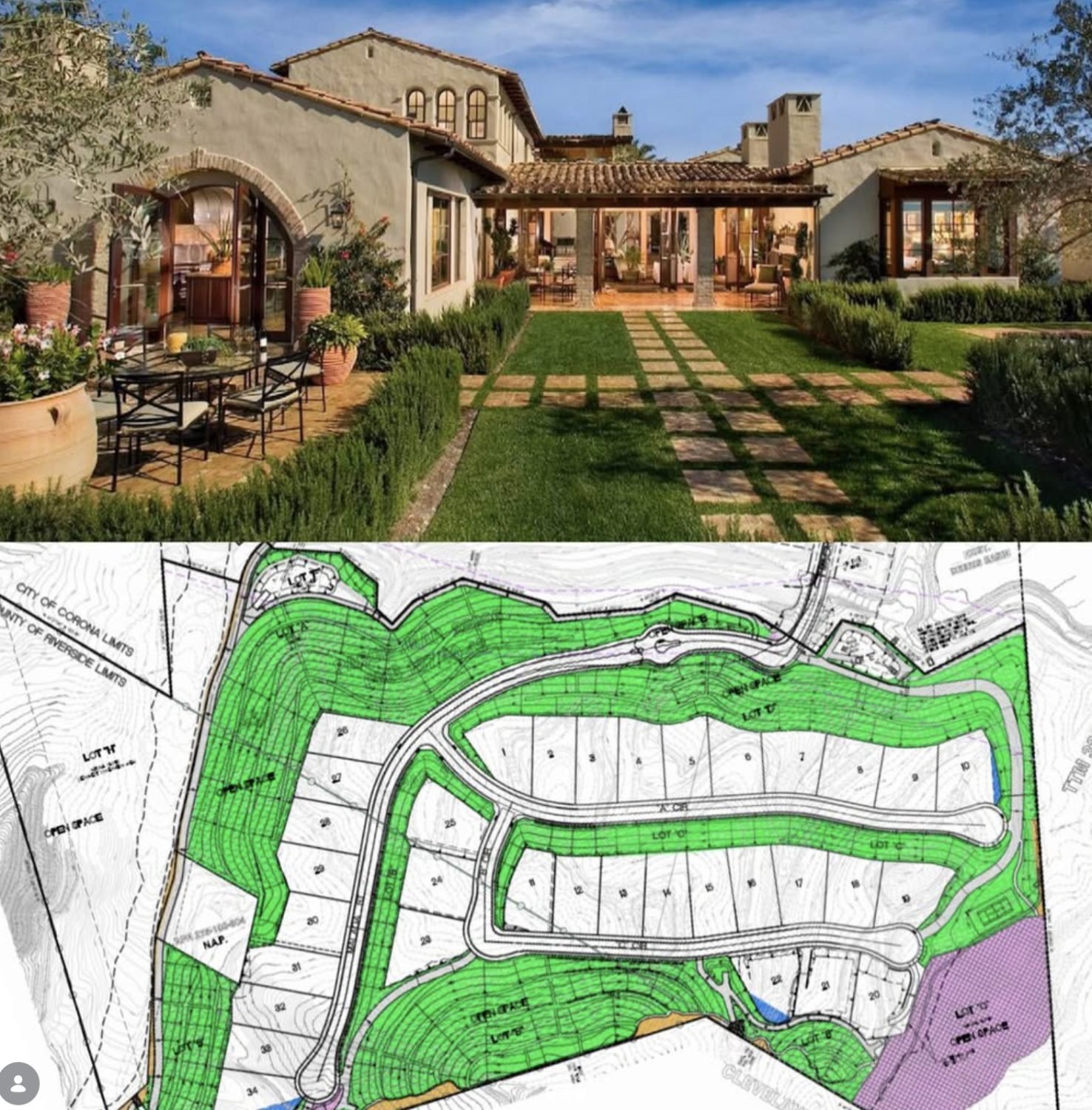
How I structure entities
People ask me this constantly. This is one structure I have used, not a recommendation and not a tax strategy: California generally charges its annual LLC tax on every LLC doing business or registered here, so do not read this as a way around it. What the shape does do, when the formalities and the facts support it, is help separate risk between ventures and keep less of your name in the public record. Have California counsel and a CPA review any structure before you file.

Legal and smart, but structure is state-specific and personal. I am not an attorney or a CPA. Build this with your own legal and tax team before you rely on it.
The full entity map
Once you own more than a few things, a flat pile of LLCs stops working. Group them by how they behave: money that turns over fast, money that sits and compounds, and the service businesses that feed both.
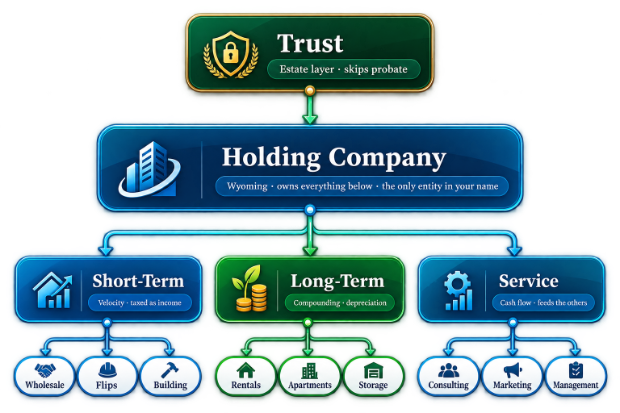
One trust, one holding company, and separate entities beneath it. Separation can help isolate liabilities when the formalities and the facts support it; guarantees, direct liability, and alter-ego findings can still reach across.
From informed to in the game
You can read the books, work the podcasts, hit the events and the masterminds, and still stall, because clarity, not confidence, is what’s missing. Close the gaps and move.
The wall is rarely courage. It’s not knowing how to underwrite, what the fields mean, where to find deals, who to partner with, or how to raise capital.
Clarity kills fear. When you know your numbers and the possibilities, value-add, rehab, expansion, you place offers you feel solid about instead of afraid of.
The worst thing a seller can say to an offer is no. That’s survivable. Never making the offer isn’t.
Take action tomorrow, not “next year.” Momentum is a decision, made once and then again.
· What single gap is actually keeping me on the sidelines?
· What offer could I responsibly make this week?
· What am I calling “not ready” that is really just fear?
Choose the story you operate from on purpose, stop narrating scarcity, and make it physical: one want, one decision, one move through the fear this week.
Set the company up right
Before the first deal, build the container that holds it. None of this is legal advice, it’s the checklist I run, then confirm with a professional.
An LLC separates the business from you personally, so a problem at the property stays at the property.
Profits flow to your return without a second layer of corporate tax, simple and efficient.
The rulebook: who owns what, who decides what, and what happens when things change.
A federal tax ID and an agent of record, the basic plumbing of a real entity.
Never commingle. Business money lives in the business, from day one.
Clean bookkeeping isn’t optional. Lenders, partners, and the IRS all read it.
Boring, and non-negotiable. The container is what lets you scale without chaos.
The pieces, in plain English
The diagram is simple once you know what each box actually does. Six terms carry the whole structure.
This is how I structure mine, shared for education. Entity and estate law is state-specific: build yours with a real estate attorney and a CPA.
Investing into the U.S. from abroad
The U.S. offers strong returns and more cost-effective assets than many home markets, which is why I work with investors from Canada and beyond. Get the structure right and the door is wide open.
The states are very doable for a foreign investor. Don’t let the paperwork scare you off the better returns.
Get the home-country structure sorted first, often a corporation or partnership arrangement, before you take ownership in the U.S.
A holding company then owns the U.S. LLC interest. Structure coordinates two tax systems; it is not a shortcut around tax. Get U.S. and home-country advice before the first entity or the first wire.
This is general education, not legal or tax advice. Work with a cross-border professional and confirm every step.
· Which market’s returns am I leaving on the table out of fear of the setup?
· Who is the right cross-border professional for my situation?
· What’s the first structural step I can start this month?
Partner to fill the gaps
No one is strong at everything. Partnership is how you assemble a complete operator out of complementary people, and move faster with less risk.
Someone brings the money so a good deal doesn’t die for lack of funding.
Someone who finds and works off-market deals others never see.
Someone who can read a deal cold and tell you the truth about the numbers.
Someone who runs the asset day to day and keeps the standard.
Someone whose financials qualify for the loan the deal needs.
Two complete halves close faster and carry the downside together.
List your strengths, name your gaps, then find the missing puzzle pieces.
Distributable cash pays the preferred return first, then returns capital, then splits over the hurdle, the promote. Test the waterfall with real numbers before you accept a dollar, and put the definition of distributable cash in writing. Most partner fights are a missing sentence, not a missing dollar.
The four seats at the table
Most partnerships are built from four roles. Know which seat you’re taking before you shake hands.
Focus on roles and responsibilities first; the equity split follows the work.
Money that only wants a return is the cheapest money you will ever take. Investors who participate economically without governance rights, board seats, or a vote on your decisions cost you profit, not control. Define their rights up front, in the documents, so nobody has to negotiate them later under pressure.
Structure it before the deal
Every good partnership is boring on paper, because the hard questions were answered before the money moved. Define these up front.
Who does what. Named responsibilities, not vibes.
Who funds how much, and what that buys.
The order money is returned and split as the deal performs.
Who decides what, and where a vote is required.
How a partner leaves, and how the others are protected.
The agreed path when you disagree, before you do.
A side agreement outside the operating agreement is intent, not ownership. In an LLC the operating agreement is the binding document. Partners sign a term sheet, feel protected, then find at the first refinance that none of it was implemented.
A clear agreement is not distrust. It is the kindness of removing future ambiguity.
One term to define plainly, because it appears in every partnership document: a key principal, or KP, is the person a lender holds personally accountable for the deal. They sign or guarantee, they carry the net-worth and liquidity requirements, and their track record is what the loan is really underwritten against. Bringing a KP to a deal is a contribution as real as cash. Price it that way.
When partners disagree
Conflict isn’t the end of a partnership, unmanaged conflict is. Build the systems that let a hard conversation stay a conversation.
Set expectations at the start. Most conflict is just an unspoken assumption meeting reality.
Keep a communication cadence, a standing check-in beats a crisis call every time.
Document decisions as you go. Memory is a poor arbiter; the written record is a fair one.
Build in mediation and a defined exit, so a disagreement is a process, not a detonation.
· Where have I left an expectation unspoken with a partner?
· What cadence would keep small issues from becoming big ones?
· Is our exit path written down, or just assumed?
Your strengths, your gaps, your next move
Delegate to elevate
You can’t scale what only you can do. A virtual assistant is often the first hire that buys back your time, and your focus.
Delegate the tasks that bog you down or drain you, so your hours go to the work only you can do.
Find talent on Upwork, Fiverr, dedicated job boards, and community groups, the pool is deep and global.
Define the role, source several candidates, interview, and run a small paid trial task before you commit.
Build the relationship before you desperately need it. You don’t have to hire today, but start looking today.
· What draining task could I hand off within a week?
· What would I do with the hours a VA buys back?
· What role should I scorecard before I hire?
Three levels of ownership: the start-up with no control and no freedom, the owner-reliant company with control but no freedom, and the owner-independent company with both. Ask once a quarter where you are still essential and where someone else should already be leading. That gap is your entire job for the next ninety days.
Work ON the business, not IN it
Michael Gerber named this in The E-Myth, and it has been operator shorthand ever since. My own test is simpler: if it stops the moment I step away, I still own a job, not a business.
A name and mark people remember, DIY or a designer, but do it.
A repeatable way leads find you, not luck each month.
One system of record so nothing falls through the cracks.
Write the process once so anyone can run it right.
Let tools multiply proven wisdom, not replace responsibility.
Design the machine; stop being the machine.
Every hour spent on the business compounds. Every hour lost in it just repeats.
Keep more, legally
Real estate is one of the most tax-advantaged assets there is. Know the levers, and work with a real-estate CPA to pull them right.
Write down the building’s value against income over time.
Front-load depreciation by breaking the asset into faster-depreciating parts.
Roll gains into the next property and defer the tax. Since July 2025, 100% bonus depreciation is permanent for property acquired after January 19, 2025.
Loan interest is generally deductible against the income.
Accelerate deductions in the years the code allows.
Interview several real-estate CPAs, even referrals. They needn’t be local.
Not tax advice, the map. A good CPA is the guide who walks it with you.
Illustrative only, and simply what I do: this is not tax or legal advice. Work with your own real estate CPA and attorney.
Fund the deal
The capital stack should fit the business plan and the hold. Match the money to the mission, not the other way around.
Long-term, lower-rate debt for qualifying stabilized assets.
Short-term capital to buy time for a value-add plan.
The seller becomes the bank, flexible terms, faster close.
Pull created equity back out to recycle into the next deal.
Speed and certainty when the deal can’t wait on a bank.
Pool many investors behind one larger acquisition.
Cheap money on the wrong plan is still the wrong deal.
Government-backed debt belongs in the toolbox. SBA 7(a) funds business purchases and working capital, and down payments have started near ten percent in recent years, though program terms and each lender’s credit box change; confirm current requirements before you plan around a number. SBA 504 funds owner-occupied real estate and heavy equipment at long fixed rates, and owner-occupied is the operative word: your operating business generally has to occupy most of the building, and pure rental investment is not eligible. For an operating business attached to its real estate, this is often the cheapest patient money available.
Underwrite it in about a minute
I built the model I actually use into a calculator and made it free for life. Enter a handful of numbers and you get a full five-year pro forma, the lender metrics, and a plain verdict: bad, good, or stellar. Most deals die in that minute, and that is exactly the point.
Get it free at UnderwritingCalculator.com, and bring the deal to The REal Circle when you want more eyes on it. The number is what gives you the nerve to make the offer.
Run it in a minute: address and your price → honest income → real expenses → the debt you can actually get → read NOI, cap, DSCR, cash-on-cash → write the walk-away before you call. The step-by-step video walkthrough lives at UnderwritingCalculator.com.
Walk in knowing your own numbers
A lender is not deciding whether they like you. They are deciding whether they can defend the loan to a committee. Give them the file that lets them do it.
Read the personal guaranty before you sign it. It is the clause most often signed unread, and it moves the debt from the entity to your household. Know exactly what you pledged.
Certainty is what you are actually selling, to a seller and to a bank alike. Bring it in writing.
When the deal needs more money
It happens. Costs run, timelines slip, a tenant leaves at the wrong moment. How you handle the ask determines whether your investors ever fund you again.
You will be forgiven for a deal that needed more money. You will not be forgiven for finding out about it last.
Before you sign anything, ask one question and get the answer in writing: in a sale, who gets paid before I do, and how much? Preferences stack. Operators have sold for real money and walked away with nothing, not from one bad clause but from years of ordinary ones. Know the waterfall before you need it.
Deciding to sell before the market decides for you
Most owners sell because they are tired or because something broke. Both are the worst possible timing. Decide your conditions in advance, in writing, while nothing is urgent.
Selling well is not the opposite of conviction. It is what makes the next conviction fundable.
The plan is a hypothesis, not an obligation. Once a year, re-run five numbers: forward NOI with honest reserves, current debt and refinance quotes, remaining value-add, the tax and waterfall math of a sale, and what would have to change the answer. Hold, refinance, or sell is a decision you re-earn annually.
Take the next step with me
I help people take action in real estate, through the systems, technology, and underwriting I built over years. If any of this lit a fire, here’s how we keep going together.
Underwrite a deal in under a minute, plus a mini-course to get you started today.
Step-by-step: entities, partnerships, underwriting, financing, and scaling.
Direct guidance on your deals, your structure, and your next move.
Build alongside others doing the same work, and never feel alone in it.
Every week, real deals and real accountability. Bring a question, leave with a next step.
The 90-Day Month
Split one day into three. Each segment runs like its own full day, so one day produces what three used to. Not more hours, more leverage.
Live it and you get the 90-Day Month: three days of output from every day, ninety from every thirty. That is the whole promise of this part.
Time is not the scarce resource
Everyone gets the same 24 hours. The difference between a stalled year and a breakout year is never the clock.
Attention is the scarce resource. Leverage is. Systems are. Time just keeps score.
Most people do not need more hours. They need fewer distractions and a better operating system.
Movement is not progress. The calendar can be completely full while the needle never moves.
The goal is not working longer. It is splitting one day into three real segments so a single day produces what three used to, without burnout.
· Where am I mistaking movement for progress?
· What would I eliminate if output were the only measure?
· Which single hour today deserves triple weight?
The multiplier equation
Most people run the old equation and wonder why the output never changes. Swap the equation and the same hour starts paying several times over.
Each multiplier compounds the others. Add one and the hour doubles. Stack them and it explodes.
The Five 20% Rule
Pareto’s principle is well known and not mine: eighty percent of results come from twenty percent of activities. My extension is what to do with the rest. Most people keep grinding the other eighty. I delete it and stack five twenties instead.
Sometimes your 80% is as good as someone else’s 100%. Perfection destroys speed, delays feedback, and keeps builders poor.
An 80% solution shipped today beats a perfect one six months late. Five strong twenties at that standard is a whole hundred, five times over.
Not the textbook: if the twenty percent of effort you give something produces a result that passes, as good as most people’s hundred, then one life holds five twenties. Businesses, faith, family, passions: five majors, none starved, no salary cap on who you get to be.
Run the twenty percent five times
Pareto says twenty percent of your effort produces eighty percent of your results. Most people hear that and try to polish the last twenty. I hear something else: if eighty percent is enough, I have four more twenties left in the day.
Eighty percent is a strategy, not an excuse
Your eighty is often better than someone else’s hundred, and it arrives months earlier. That is the whole edge. But it is a scalpel, not a hammer, and using it in the wrong place will cost you everything you built.
Where eighty percent is enough, and where it never is
This is the part people skip, and it is the part that keeps the whole doctrine honest. Passable is a strategy in most of life. In a few places it is a disaster, and knowing the difference is the actual skill.
Stack the passable. Never stack the sacred. If you cannot tell which is which yet, ask who pays when it fails.
How to actually find your twenty percent
Everybody nods at Pareto and then changes nothing, because they never do the boring part. You cannot cut what you have not measured. Two weeks of honesty gives you the rest of the year.
You are not looking for more hours. You are looking for the handful of hours that were carrying everything all along.
What the other four twenties are for
Here is where most productivity teaching goes wrong. It frees your time and then hands it straight back to the job. Faith first. Family always. Freedom as the fruit. That order is the whole system.
The math is simple: five twenties make a hundred. Spend the first twenty on the work that pays and you still have four twenties left — four more lanes, not twenty-one through twenty-five. Four real lives, running at once, inside one honest hundred percent.
You do not have a salary cap
Eight hours is not your capacity, it is your contract. The moment you stop measuring yourself in hours sold and start measuring in outcomes produced, the ceiling turns out to have been a habit.
One job. One income. One lane. Eight hours sold at a fixed rate, and a quiet agreement that the rate is the ceiling.
Nobody put that ceiling there. You inherited it, and you have been decorating it ever since.
You were not built for one lane and a ceiling. Run the twenty, keep the standard honest, and spend what you win back on the things that were always the point.
The year that proved it
I had been running some version of this for years before the world shut down. Then 2020 arrived and tested every part of it at once. I lost opportunities. I hit almost none of my goals. Plenty of businesses I loved never opened their doors again.
And it still became one of the best years of my life. Not because it went to plan, but because when the plan died I built new goals inside the situation I actually had, instead of grieving the one I had lost.
That was the year the world discovered what I had been arguing all along: work is not a place, and productivity is not a block of hours between eight and five. Employers watched output go up while offices sat empty. The mold cracked in public.
The framework was not invented in a good year. It was proved in a terrible one. That is why I trust it.
When the goals die, the system does not
Some years take your plan away in one motion. A market turns, a job ends, a marriage ends, a diagnosis lands. Goals are fragile by design. A system is what keeps producing when the goals are gone.
Do not mourn what was taken. Hold your hands out and receive what is newly available.
Three elite blocks beat twelve distracted hours
Multitasking is fake. Every glance at the phone leaves attention residue, and every context switch taxes your thinking. The fix is not discipline all day. It is total focus in blocks.
Twelve hours, sliced by pings, tabs, and drive-bys. Busy all day, nothing shipped.
Phone away. Email closed. Notifications off. Nothing else exists until the block ends.
Protect three of these and the day is won before lunch has a chance to ruin it.
What a stacked week actually looks like
Not five jobs happening at once. Five things each owning a defended block on a repeating grid, so nothing has to be decided twice. Illustrative, and close to how my own week runs.
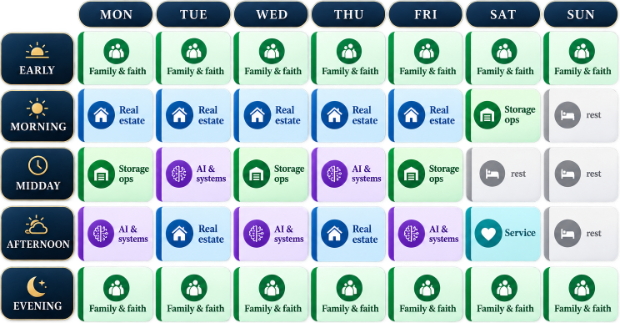
Five majors, every block owned in advance, rest built in on purpose. The week is decided before it starts.
One day, run as three
Morning, afternoon, evening: each runs as its own complete day, with its own mode, its own wins, its own shutdown. Most people waste the transitions. I design them.
How I stacked careers without stacking hours
In my design years I ran W-2 leadership, 1099 consulting, real estate, and side businesses at the same time. The secret was never more hours.
Each pursuit lived in its own focus block, with its own number and its own cadence, and never bled into the others.
Some roles need bursts, some need maintenance, and some produce passively once built. Match the block to the mode.
Portfolio thinking: instead of one career, build several that feed each other. Design fed real estate. Real estate fed the businesses.
One career is a single point of failure. A stack of them turns every hour into an hour that feeds several futures.
· Which of my pursuits is in burst mode, and which just needs maintenance?
· What second lane could my current skills open this year?
· Where am I letting one lane bleed into another’s block?
Run machines, not marathons
One person can oversee storage, restaurants, real estate, and software, if the businesses are machines. Orchestration replaces labor.
Happens twice? Write the SOP while you do it the second time.
Happens five times? Wire it to software, AI, or a workflow.
Happens ten times? Hand it to a person with a scorecard.
If the business depends entirely on you, it is not a business. It is a job with overhead.
The remote advantage, and the only honest metric
Hours worked is a vanity metric. It measures attendance, not value. Results produced is the only number that never lies.
The remote operator often outruns the office: no commute, no drive-by interruptions, a custom environment, and longer unbroken blocks.
One conversation can outperform a hundred hours: one acquisition, one financing term, one design decision that unlocks the product.
Judge yourself and your team on outcomes, not presence. A results-based culture finds the leverage fast, and exposes the theater faster.
Standardize the small stuff, meals, clothes, calendar, so the brain is saved for the million-dollar decisions.
· What outcome would make this week a win regardless of hours logged?
· Which recurring meeting should become a dashboard?
· Where is presence pretending to be productivity on my team?
Six things that break the stack
I have broken this doctrine every way there is. If you are going to run five twenties, know exactly how it fails, because it fails the same way every time.
The doctrine is not permission to be busy. It is permission to be effective in more than one place, which is a different thing entirely.
You do not owe your life to one lane
A salary is one price for one lane, and most people accept it as a ceiling on who they are allowed to be. The stack is how you buy back the rest, and the rest is the actual reason for any of this. I lived well on a half-million-a-year design career and still traded it for ownership: a 9-to-5 becomes a 24/7, but work on the business instead of in it and the 24/7 stops being a job and starts being a life.
You are capable of more than one lane. Shoot for the moon, because landing in the clouds beats aiming at the clouds and landing in the trees.
Guard your time like the asset it is. The most successful people I have ever been around say no far more than they say yes; they are laser focused on the few moves that actually advance the mission. Helping others is good, but an unmanaged yes makes you a slave to other people’s noise, overextended and failing at the things that count.
The 80/20 and the 90-Day Month let you do more than you ever have. The discipline is doing it selectively.
What one hour becomes
Leverage stacks multiply, they do not add. Each layer you install re-prices every hour you have ever worked and every hour still coming.
This is how you live ninety days a month of output while the calendar still shows thirty days.
Design your 90-day month
(times & missions)
(the 2-5-10 list)
The Fillable Toolkit
Every framework in this book, as a page you can actually fill in.
Morning Alignment Card
Fill this before the phone.
The Daily Three
One of each, every day.
Weekly Review
Same time each week.
Weekly Scorecard
Score behaviors, not moods.
90-Day Rebuild Plan
Long enough to change, short enough to feel urgent.
The Open-Loop Ledger
Turn anxiety into inventory.
The Decision Filter
Run it before you commit.
Trigger Plan
Rewrite the first 60 seconds.
Restriction Audit
Clear space for something better.
Energy Audit
Treat energy like capital.
Purpose Statement
Sounds useful, not impressive.
The Personal Oath
Sworn to God, not to my mood.
Confession & Repair Log
Ownership, then changed behavior.
Trust Ladder Review
Trust is earned in levels.
Buy Box
Clarity makes speed safe.
Deal Analyzer
Love the numbers, not the property.
Market Underwriting
Migration first, property second.
Cold-Call Tracker
Inputs you control.
Seller Call Sheet
Qualify on four pillars.
Offer & Structure Sheet
Price is one lever of many.
Follow-Up Cadence
Most deals live here.
Deal-Machine Scoreboard
Track the funnel, not just wins.
Dispositions / Exit Plan
Know the way out first.
Storage Acquisition Checklist
Verify before you buy.
Facility Turnaround Plan
Name the levers and the owner.
Revenue-Management Plan
Where NOI is made.
Role Scorecard
Hire for outcomes.
Job Post Builder
Attract right, repel wrong.
Interview Scorecard
Reveal, don’t just like.
SOP Template
If it isn’t documented, it isn’t delegated.
Weekly Team Meeting
Same agenda every week.
KPI Dashboard
You improve what you can see.
Content Calendar
One promise, said many ways.
Offer Ladder Planner
Sell the first rung first.
Enrollment Call Sheet
Diagnose, then invite.
Annual Plan
Themes, not a hundred goals.
Family Rhythm Plan
What you schedule, you protect.
Personal Board of Advisors
No one builds alone.
Glossary & Reference
The words behind the work, so you can teach it as fluently as you run it.
Self-Storage
Self-Storage, continued
CRE & Finance
The bottom was not the end of their story. It was the middle of it.
CRE & Finance, continued
CRE & Finance, continued
Acquisitions & Wholesaling
Acquisitions & Wholesaling, continued
Team, Ops & The REbuild
Team, Ops & The REbuild, continued
Net operating income (NOI)
Everything the property earns, minus what it costs to run, before the loan. Income in, expenses out, debt and big projects stay off this line.
Cap rate
The market’s price for a dollar of income. You do not set it; you inherit it from the trade area and the moment.
Property value
Flip the cap rate around and you get the whole value-add game on one line.
Debt service coverage ratio (DSCR)
The cushion between what the building earns and what the bank collects. The number that decides whether debt is a tool or a trap.
Revenue per available square foot (RevPAF)
Occupancy and rate collapsed into one honest number. Not “are we full,” but “is every foot earning.”
Economic occupancy
Full units do not pay the loan; collected dollars do. This is the honest twin of physical occupancy.
Breakeven occupancy
The floor. How empty the property can run before it starts feeding on you.
Cash-on-cash return
The return on the dollars you actually wrote the check for, not the appraised story.
Loan-to-value (LTV)
How much of the deal the bank carries. The rest is your skin, and your margin for error.
Effective gross income (EGI)
What you truly collect once you subtract the units that sit empty and the rent that never shows up.
Operating expense ratio
How lean the operation runs. It tells you how much of every dollar collected is eaten by running the place.
Debt yield
The lender’s stress test: the return they would earn if they foreclosed and owned the income outright.
Equity multiple
The simplest measure of the whole ride: how many total dollars come back for each dollar you put in.
Yield on cost
What you build by forcing value, versus what you buy at the market’s going rate. The gap is your reward for the work.
Gross rent multiplier
A fast first glance before the real underwrite. It compares price to rent without touching a single expense.
Price per square foot
The plainest comp there is. Put every building on the same footing and compare like with like in one trade area.
Loan-to-cost (LTC)
What the lender is funding against everything the project actually costs, land, purchase, rehab, and soft costs included. The number that governs development and heavy value-add.
Physical occupancy
How many doors have a body or a lock on them. The number every seller leads with, and the one that flatters a property the most.
Loan constant
What one dollar of borrowed money costs you every year, all in. The fastest way to compare two loans that quote different rates and terms.
Value created
What a dollar of new NOI is actually worth on exit. This is the number that justifies the work, and it is why operators chase NOI instead of hoping for appreciation.
Loss-to-lease
The gap between what the market would pay and what your tenants are actually paying. Free upside sitting on your own rent roll.
Renovation ROI
What a rehab dollar earns back every year in new operating income. The test that separates real value-add from expensive decorating.
CapEx per unit
Big projects divided by doors. It keeps a renovation honest: the number you spend has to come back through the rent roll.
Replacement reserve per unit
What you set aside every year for the roof, the HVAC, the parking lot, and everything else that will eventually fail on your watch.
Development spread
What you build to, against what the market pays for it finished. The whole case for taking construction risk lives in this gap.
Tenant protection penetration
What share of eligible storage tenants carry protection. High-margin income that most independent operators leave almost entirely on the table.
Move-in conversion
How many qualified leads actually become paying tenants. The cheapest occupancy gain in the business, because you already paid for the lead.
Cost per rental
What one new tenant costs you to acquire. Read it beside their expected stay, or the number means nothing at all.
Net present value (NPV)
Every future dollar, discounted back to what it is worth today, minus what you put in. The honest answer to whether the wait was worth it.
Internal rate of return (IRR)
The annualized return that makes a deal’s cash flows worth exactly what you paid. It accounts for timing, which is the whole point.
Weighted average lease term
How long your income is actually locked in, weighted by how much rent each lease carries. Your real exposure to rollover.
Parts I–V, distilled
Fifteen parts, one operating system. Here it is, a line at a time.
Faith is the posture you choose before the plan is proven.
Truth is cheaper than pretending; repair is a leadership skill.
A crowded life can’t receive a clear calling. Restriction makes room.
One money move, one repair move, one system move, daily.
One mission, many vehicles, and a mission that organizes them.
Repair before expansion. Systems before scale. Alignment before ambition.
Parts VI–X, distilled
Caring is preparation. Standards repeated become culture.
You’re most qualified to serve the person you used to be.
A pipeline you can trust beats a hot streak you can’t repeat.
You can’t scale yourself, only multiply yourself.
Vision gets the deal; operations keeps it.
Care in advance, document everything, inspect what you expect.
Parts XI–XIII, distilled
Teach the system, not just the story. Protect people, share principles.
Faith first, family always, freedom as the fruit.
A manual you don’t run is just a book you bought.
Keep going, but not the old way.
Every framework as a page you can fill in.
Practiced, not admired. It has to work on a Monday.
The frameworks to keep on the wall
If the book fell in a puddle, these are the pages worth drying out.
Money, repair, system, every day.
Trust is earned in levels, on repeated behavior.
Core, adjacent, and bets, focus with math.
Delete before you optimize; automate last.
Buy box → leads → call → offer → follow-up.
Where drift is caught early and the system stays alive.
The operating cadence at a glance
What you schedule, you protect. Run the whole system on this clock.
Morning alignment, three moves, presence, reset.
Weekly review, scoreboard, team meeting, sabbath.
Cash rhythm, pipeline, repairs, KPIs.
Rebalance 70-20-10, re-read the oath, set 90 days.
Themes, big rocks, capacity, who you’re becoming.
Communicate before silence creates harm.
Freedom is not doing whatever you feel like. It is enough discipline to choose the future you actually want.
Build your stack
Tools serve the system, never the other way around. Categories to cover, pick what fits.
One board every lead and deal lives on.
Calls, texts, and follow-up at volume.
Lists and owner contact, kept clean.
Rates, occupancy, delinquency, reporting.
Clean books, real reserves, honest numbers.
SOPs, contracts, and signatures without friction.
Red flags: when to walk
Two kinds of red flag will end a deal. One lives in the numbers and the seller. The other is standing in front of you when you walk the building. A big-ticket item is only bad if you did not expect it.
Walk it with an inspector or a contractor you trust, take notes, then get real quotes on everything you flagged. Rough ranges are for the offer. Real bids are for the close.
How to use this manual, and the free edition
This is the full manual: read it in any order, but practice it in rhythm, daily, weekly, quarterly.
Mark it up. Turn its pages into your own SOPs, scripts, and scorecards. It’s built to be run, not shelved.
A trimmed free edition carries the core ideas as an on-ramp; this full version carries the playbooks and the toolkit.
If a page doesn’t change a decision, it hasn’t earned its place. Keep what works; rewrite the rest in your own hand.
Start here
Don’t try to run all fifteen parts at once. Begin with these and let momentum build.
Write it, sign it, let it govern the hard moments.
A short alignment before the phone, every day.
One money, one repair, one system, starting today.
Same time each week; catch drift early.
Prove the system works on something real.
Score behaviors, not outcomes. Proof builds momentum.
The non-negotiables
Everything else can flex by season. These do not.
The posture I choose before the plan is proven.
Reality kept current, even when the news is bad.
Presence scheduled and protected, not what’s left.
Return, own, correct, improve, fast.
Build the machine instead of carrying the weight.
The same person in every room.
Keep going
Not the old way. The road forward is built one faithful action at a time.
This only works if you run it.
A manual is potential. A practiced manual is a different life. The gap between them is nothing but the next small, faithful action.
Sign the oath on the next page, and keep going, but not the old way.
The Morning Alignment
Run this before the phone wins. Ten minutes, same order, every day.
The Daily Three scorecard
Score the day before it ends. Three checks is a won day, no matter what else happened.
Before the cold call
Ninety seconds of prep beats ten minutes of recovery. Run this before every dial block.
Before you send the offer
An offer is a promise with a number on it. Check every line before it leaves.
Takeover day one
The first day you hold the keys to a facility sets the tone for the whole hold.
The Weekly Review
One hour, same day every week. This is where drift gets caught before it becomes a ditch.
Onboarding a new VA
The first two weeks decide whether you hired leverage or bought a babysitting job.
The quarterly audit
Every ninety days, put the whole machine on the lift. Half a day, brutal honesty.
Before you quit
Read this on the worst day. Check every box before you make any permanent decision.
The builders who built me
Nothing in this book is self-made. Every framework in these pages has fingerprints on it that are not mine. Before you sign the Oath, know who signed mine.
If you have people like these, tell them now, while it costs you nothing but pride.
You have the manual. Now get the reps.
A book can hand you a system. It cannot look at your actual deal, tell you the number is wrong, or sit with you on the week it gets hard. That part takes people. Here is every door I keep open, from free to the deepest.
Start at chriskirkman.com. The worst thing that happens when you make an offer is somebody says no.
Build it so it survives you
This is the least comfortable page in the book and possibly the most loving. If something happened to me tomorrow, could my family run this, sell this, or even find it? For a long time the answer was no.
A business only you can run dies with you, and that is not a legacy. Teach one person the systems, get real counsel before you get clever, and remember: if the freedom cannot outlive me, I built it for the wrong person.
The REbuild Oath
I choose faith before fear, truth before image, repair before expansion, discipline before distraction, and service before status.
I will not hide from reality. I will not let shame write my future. I will not confuse motion with progress or intensity with obedience. I will communicate before silence creates harm. I will repair what I can, release what I cannot control, and build systems where I once relied on force.
I will steward my family, my businesses, my body, my words, my money, my gifts, and my calling. I will serve the person I once was and the people God places in front of me. I will turn pressure into purpose, chaos into systems, and lessons into light.
I will keep going, but I will not keep going the old way.

Thank you for reading this
Most people do not finish books like this one. You did. That alone tells me something true about you, and it is the same thing every rebuild requires: you are willing to sit with the hard parts and keep going.
So do not let this be the end of it. Run one loop. Write your Daily Three tomorrow morning. Then stay connected, because the next part is easier with people around you.
Whatever you are rebuilding right now, I am pulling for you. Go make the offer.


Twenty years of building, both hands still on the craft
A product and UX design leader across fintech, healthcare, AI, government, and real estate, in VP, Director, and Head-of-Design roles, plus his own studio, Kirkman & Company.
He builds and operates too: self-storage in multiple states, commercial real estate, restaurants, and AI tools. One mission across many vehicles, turning complexity into value.
An Eagle Scout and former pro-skate stuntman who leads the way he was taught: from the front, and leave it better than you found it.
This manual is the operating system underneath all of it. Written in the fire, meant to be handed to the next builder.
Faith first. Family always. Freedom as the fruit.

The book ends here.The work does not.
Everything in these pages is running live right now: the calculator I underwrite with, the weekly room where operators bring real deals, and the essays I publish as I learn. Pick one and start tomorrow.
Enter a handful of numbers and get the full five-year pro forma, the lender metrics, and a plain verdict: bad, good, or stellar.
Bring a real deal, a real number, or a real problem. Leave with a decision and a room that holds you to it.
The podcast and the essays: what I am actually doing this week, stated plainly, with the numbers attached.